Acid Attack in India
Introduction
The 2009 Shaheen Malik acid attack case’s 16-year legal battle revealed significant shortcomings in the investigation, prosecution, and judicial sensitivity of India’s legal system, and the accused’s acquittal brought to light the terrible realities faced by survivors.
What is an Acid Attack?
- The intentional throwing of any corrosive substance, such as sulfuric, hydrochloric, or nitric acid, on a person to cause harm is known as an acid attack. These assaults cause serious burns and lifelong deformity, especially to the face, which frequently results in blindness and long-term physical handicap.
- Survivors experience severe psychological anguish, societal humiliation, and loneliness in addition to the excruciating physical suffering.
- Many are pushed into protracted court fights in their quest for justice, lose their jobs, and become dependent on lifetime medical care.
- The Law Commission of India’s 226th Report (2009) emphasized the gendered aspect of acid assaults, recognized them as crimes that cause long-term bodily and psychological trauma, and demanded specific penal procedures and rehabilitative assistance.
What are the Motives of Acid Attack?
- Rejection of romantic or marriage proposals: This is the primary motivation. The attacker uses acid to “punish” a woman for declining a romance, marriage, or sexual advances.
- Jealousy and revenge: Attackers may be motivated to seek retribution by breakups, suspected extramarital affairs, or jealousy. Acid is selected because it results in obvious, long-lasting harm.
- Family and domestic disputes: Acid assaults can occasionally result from disputes about dowries, inheritance, divorce, or home control, particularly within families.
- Honor-based motives: Attacks are also connected to perverted notions of honor or shame, where an individual is targeted for allegedly bringing dishonor to their family or community.
- Sexual violence and harassment: Acid is used as a last act of dominance to destroy the victim’s identity and independence when stalking or harassment fails.
- Property, business, or financial disputes: Acid assaults over land, money, or commercial conflicts also happen, albeit they are less frequent.
- Hatred and discrimination: Some attacks, which use acid as a weapon of terror and humiliation, are driven by caste, religion, or social prejudice.
What is the Impact of Acid Attack?
- Physical impact
- Severe burns from acid can damage muscles, skin, and occasionally bones. Many survivors sustain irreversible injuries to their faces, necks, and upper bodies or lose their vision.
- Long hospital stays, numerous operations, and ongoing medical care are common components of recovery. Pain and physical restrictions may persist even after treatment.
- Psychological and emotional effects
- Deep emotional trauma is common among survivors. Post-traumatic stress disorder, anxiety, depression, and low self-esteem are prevalent. Observing long-term changes to one’s looks can be emotionally draining.
- Social impact:
- Survivors of acid attacks may experience prejudice, social humiliation, or loneliness. They might be stared at, shunned, or handled differently by others.
- Particularly in traditional societies, this can put a strain on friendships, family ties, and marriage possibilities.
- Economic impact
- Due to physical harm or social rejection, many survivors are unable to pursue further education or employment. Families may experience long-term financial difficulties due to high medical costs and income loss.
- Impact on family and community
- While providing care for the survivor, families also experience emotional and financial hardship.
- In general, acid attacks restrict freedom and independence by instilling fear in society, particularly among women.
What is the Current Situation of Acid Attacks in India?
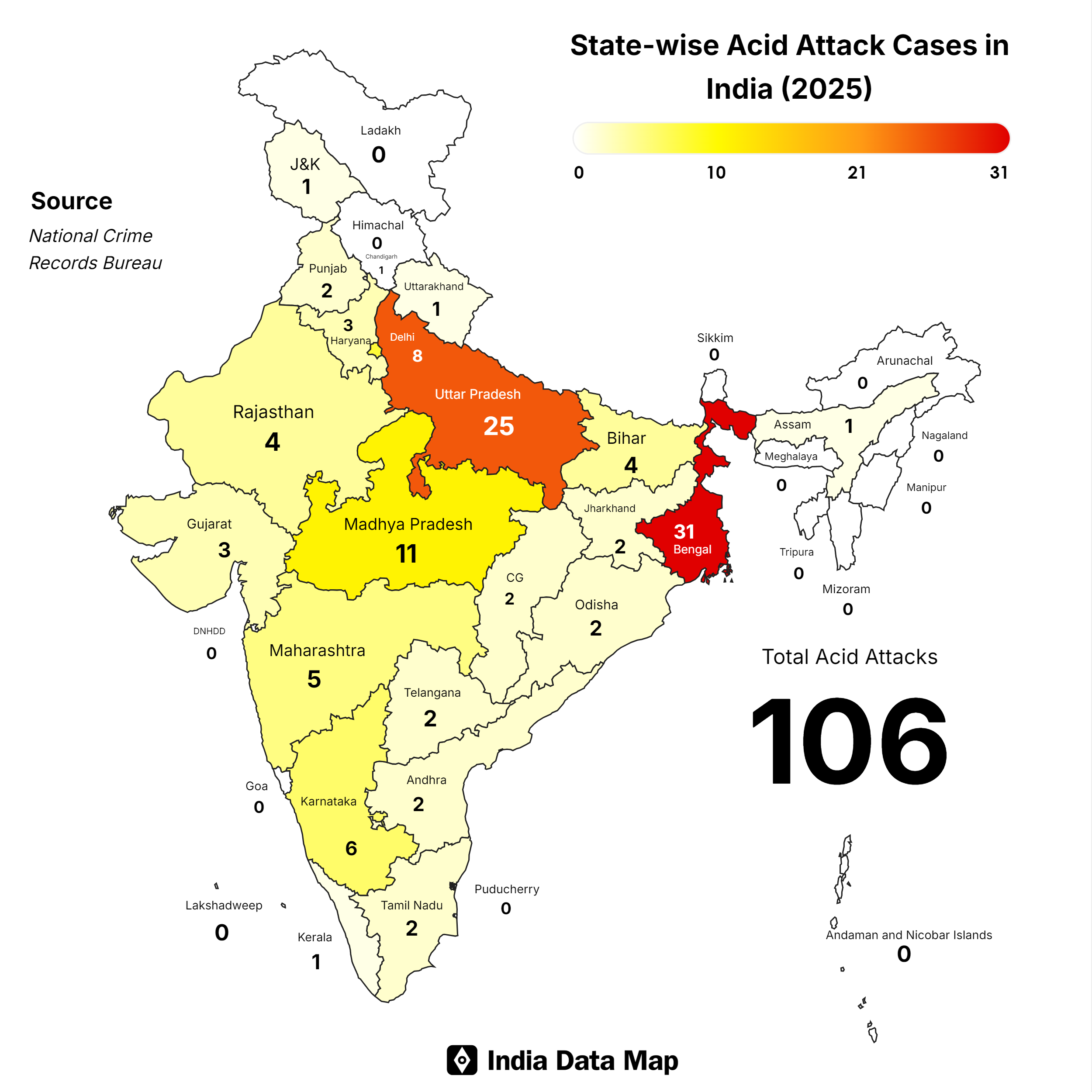
- High pendency: Due to systemic delays, 88% of acid attack cases were still pending in court as of 2025.
- Conviction rates: Despite strict laws, convictions continue to be rare.
- Underreporting: Because of stigma, fear, or a lack of confidence in the legal system, many incidents remain unreported.
- A recent example of legal delays was the acquittal of three defendants in a 2009 acid assault case by a Delhi court in December 2025.
What are the Laws Against Acid Attacks in India?
- Bharatiya Nyaya Sanhita, 2023
- Under Section 124 of the BNS, acid assaults are now considered a distinct and serious offense that carries a minimum sentence of ten years in prison, which can be extended to life, as well as a just and reasonable fine to cover the victim’s medical costs.
- Additionally, the legislation requires all public and private institutions to provide free first aid and medical treatment to victims; failure to do so could result in criminal culpability. Attempts at acid attacks are punishable by five to seven years in prison.
- NALSA Scheme, 2016
- The National Legal Services Authority (NALSA) offers priority legal aid, support, and assistance to victims of acid attacks and their heirs under the Legal Services Authorities Act, 1987, through the NALSA (Legal Services to Victims of Acid Attacks) Scheme, 2016.
- Model Poisons Possession and Sale Rules, 2013
- The sale and availability of acid were strictly regulated by the 2013 Supreme Court (SC) of India judgment, which required merchants to keep thorough purchase registers and customers to present a photo ID.
- In accordance with this directive, the Ministry of Home Affairs created the Model Poisons Possession and Sale Rules, 2013, under the Poisons Act, 1919, advising the States to create their own regulations because the topic is within their purview.
- Nevertheless, despite these guidelines and model regulations, most states continue to have inadequate and unequal implementation, which permits simple access to acid.
What are the Challenges in Providing Justice to Survivors of Acid Attacks in India?
- Weak Police Investigation: Acid attack cases frequently result in weak prosecutions and acquittals due to delayed FIRs, inadequate forensic collection, disregarded medical evidence, and an inability to identify the acid’s source.
- Chronic Judicial Delays Defeating Justice:
- Even though acid attacks are considered serious crimes, trials frequently take years.
- Justice becomes a protracted nightmare for survivors due to procedural delays, as seen by the 16-year delay in Shaheen Malik’s case.
- According to the National Crime Records Bureau, out of 703 acid attack cases that were ongoing in court in 2023, only 16 convictions and 27 acquittals were noted, indicating near-impunity for criminals.
- Victim-blaming:
- Character assassination, invasive interrogation, and a lack of gender-sensitive adjudication are commonplace for survivors, undermining their testimony and deterring legal action.
- Reporting is hindered by familial pressure, social stigma, and fear of reprisals. Independent estimates place the annual number of attacks at about 1,000, despite official numbers showing only a few hundred.
- Poor Enforcement of Acid Sale Regulations:
- The majority of the restrictions on the sale of acid imposed by the Supreme Court are still on paper.
- Repeat offenses are made possible by easy access, particularly in areas with chemical, textile, and rubber businesses.
- Normalization of Out-of-court Settlements: Survivors are frequently coerced by police and accused of taking substantial financial settlements instead of prosecution, which enables offenders to avoid criminal responsibility.
- Delayed and Inadequate Victim Compensation: The release of state funds intended for immediate medical and rehabilitation requirements frequently occurs after a number of years, placing survivors in financial hardship and impairing their ability to use the legal system.
How Can India Help Survivors and Prevent Acid Attacks?
- Stricter Regulation of Acid Sale
- Implement a complete prohibition or stricter regulations on the retail selling of acid.
- Improve the Sub-Divisional Magistrates’ administrative accountability for keeping an eye on acid sales.
- According to the Acid Survivors Foundation, Bangladesh has decreased acid assaults from 494 incidents to just 13 by 2024 by sealing illicit acid-selling stores within 30 days and launching public awareness programs since 2002. India should learn from this strategy.
- Judicial Sensitisation and Faster Trials
- Judges and public prosecutors must complete mandatory gender-sensitization training. Create expedited courts for cases involving acid attacks.
- To increase conviction rates and deterrence, penalize excessive judicial delays.
- Strengthening Legal and Psychological Support
- Assure free counseling, legal aid, and support during the trial. Lessen the pressure on survivors to accept settlements reached outside of court.
- Adjust the disability assessment guidelines under the Rights of Persons with Disabilities Act, 2016 so that victims of acid attacks are evaluated according to their functional impairment, psychological trauma, and lifetime medical and reconstructive care requirements rather than a strict 40% disability threshold, acknowledging that burn injuries cannot be determined only by skin percentage.
- In order to facilitate prompt operations and treatment, compensation should be released in months rather than years. Instead of only providing ex gratia relief, explicitly tie pay to medical and rehabilitation needs.
Conclusion
The Shaheen Malik case demonstrates how, despite robust legislation, acid assaults continue in India because of lax enforcement and low conviction rates. Deterrence depends on strict laws governing the sale of acid, expedited legal proceedings, and prompt compensation for survivors. To put an end to acid violence, a victim-centric justice and rehabilitation framework is necessary.
Frequently Asked Questions (FAQs)
What legal provision currently governs acid attacks in India?
Section 124 of the Bharatiya Nyaya Sanhita, 2023, addresses acid attacks and stipulates a minimum sentence of 10 years in prison, up to life in prison, as well as a fine for medical costs.
What was the significance ofLaxmi vs Union of India (2013)?
The Supreme Court mandated the regulation of acid sales, free medical care, and a minimum compensation of Rs 3 lakh for survivors after recognizing acid attacks as a separate crime.
Why are acid attacks underreported in India?
Owing to societal stigma, fear of reprisals, familial pressure, and a lack of trust in the legal system, the true number of cases per year may be close to 1,000, which is far higher than the official NCRB numbers.
What support does NALSA provide to acid attack victims?
The 2016 NALSA (Legal Services to Victims of Acid Attacks) Scheme provides victims with priority legal aid, counseling, and help in obtaining rehabilitation and compensation.
Sources:
- https://en.wikipedia.org/wiki/Laxmi_Agarwal
- https://www.mha.gov.in/sites/default/files/AdvisoryAcidAttackWomen_220415.pdf
- https://www.thehindu.com/news/national/where-does-india-stand-on-acid-attacks-explained/article70467417.ece
- https://www.mha.gov.in/en/commoncontent/compensation-acid-attack-victims
- https://www.indiatoday.in/india/story/acid-attack-ba-student-motihari-accused-arrested-victim-blacklists-phone-number-2858418-2026-01-27
- https://timesofindia.indiatimes.com/india/sc-asks-states-uts-to-provide-details-of-acid-attack-cases/articleshow/127618457.cms
- https://www.bbc.com/news/world-asia-india-25773382
Leave a Reply