Can AI Replace Teachers in 2025?
Introduction
Globally, Artificial Intelligence (AI) has drastically changed some industries, including healthcare, banking, entertainment, and transportation. One of the most human-centred industries, education, is currently going through its own wave of AI integration. Classrooms are changing because of tools like automated grading software, adaptive learning platforms, and intelligent tutoring systems.
The Capabilities of AI in Education
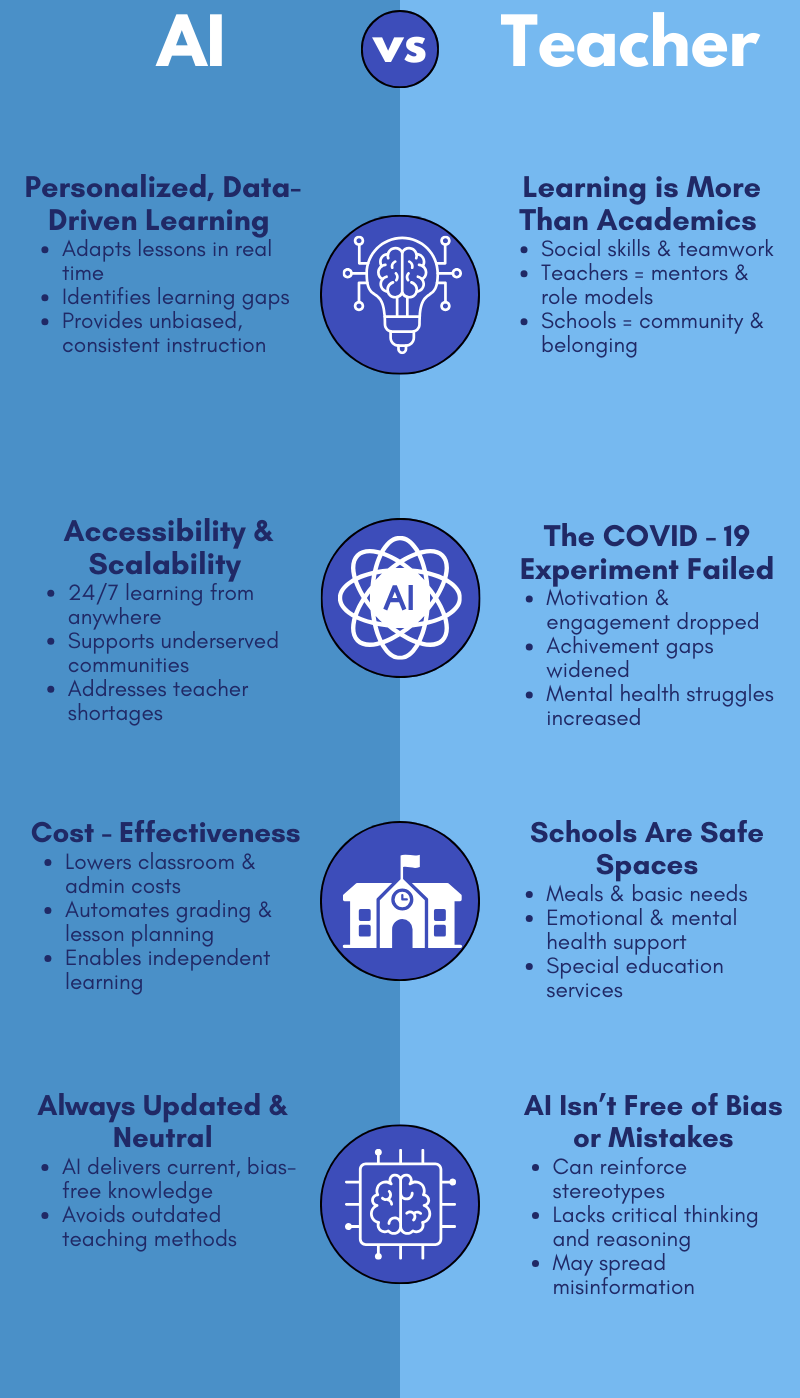
- Personalised Learning: AI algorithms can analyse student performance and tailor lessons to individual needs. For example, adaptive platforms adjust difficulty levels based on a learner’s progress.
- Automated Grading: AI can quickly grade multiple‑choice tests, essays, and even short answers, saving teachers time.
- 24/7 Availability: Unlike human teachers, AI systems can provide round‑the‑clock support, answering questions and offering practice exercises.
- Data‑Driven Insights: AI can track student progress, identify weaknesses, and suggest interventions more efficiently than manual methods.
- Language Translation & Accessibility: AI tools break language barriers and assist students with disabilities, making education more inclusive.
The Human Side of Teaching
- Empathy and Emotional Support: Students often struggle with motivation, anxiety, or personal challenges. Teachers provide encouragement and emotional guidance that AI cannot authentically deliver.
- Mentorship and Inspiration: Great teachers inspire students to dream bigger, pursue passions, and develop character. AI lacks the lived experiences and personal stories that make mentorship powerful.
- Ethical and Moral Guidance: Education is not only academic but also moral. Teachers help students navigate ethical dilemmas and social responsibilities.
- Adaptability in Complex Situations: Classrooms are dynamic. Teachers adjust lessons based on mood, energy, or unexpected events—something AI struggles to interpret.
- Human Connection: The bond between teacher and student fosters trust, belonging, and motivation. This relational aspect is central to learning.
Comparing Artificial Intelligence and Human Teachers
| Aspect | AI Strengths | Human Teacher Strengths |
|---|---|---|
| Knowledge Delivery | Fast, scalable, personalized | Contextual, inspiring, adaptive |
| Emotional Support | Limited, simulated empathy | Genuine empathy, mentorship |
| Administrative Tasks | Efficient automation | Time‑consuming, prone to fatigue |
| Creativity | Pattern‑based suggestions | Original thought, imagination |
| Ethical Guidance | Rule‑based | Nuanced moral reasoning |
| Accessibility | 24/7, multilingual | Limited availability |
Challenges and Limitations of AI in Education
- Bias in Algorithms: AI systems can inherit biases from training data, leading to unfair outcomes.
- Lack of Emotional Intelligence: Simulated empathy cannot replace genuine human care.
- Over‑Reliance on Technology: Excessive dependence on AI may reduce critical thinking and interpersonal skills.
- Privacy Concerns: AI systems collect vast amounts of student data, raising ethical questions.
- Digital Divide: Not all students have access to AI tools, especially in rural or underprivileged areas.
The Future: Collaboration, Not Replacement
- Teachers as Facilitators: AI handles repetitive tasks, while teachers focus on mentorship and creativity.
- Blended Learning Models: Combining AI platforms with classroom teaching creates a balanced approach.
- Professional Development: AI can help teachers identify gaps in their teaching and suggest improvements.
- Global Access: AI can bring quality education to remote areas, while teachers provide cultural and contextual relevance.
- Focus on Higher‑Order Skills: With AI covering basics, teachers can emphasize critical thinking, problem‑solving, and emotional growth.
Conclusion
AI is transforming education by providing accessibility, efficiency, and customisation. But teaching is fundamentally human, based on moral direction, empathy, and mentoring. These attributes cannot be replicated by AI. Collaboration, not replacement, is the way of the future. Teachers will continue to play a crucial role, but their responsibilities will change, becoming less about repetitive tasks and more about higher-order thinking, creativity, and emotional support.
Therefore, the answer is obvious: AI can enhance educators, but it cannot replace them. In order to keep education both cutting-edge and deeply human, the classroom of the future will be a collaboration between human knowledge and computer intelligence.
Frequently Asked Questions (FAQs)
Will AI take over the entire teaching job?
No, not the whole task. AI is particularly good at automating repetitive, data-intensive jobs like creating customised practice problems, monitoring student progress, and grading multiple-choice tests. It cannot, however, take the place of the crucial human components of instruction.
What can AI do better than a human teacher?
1. Provide individualised tuition around the clock by tailoring the material to each student’s pace and preferences.
2. Teachers’ time can be saved by automating administrative processes like attendance and grading.
3. Analyse a lot of data to help teachers understand where pupils are having difficulty.What can’t AI replace in a teacher’s role?
1. Understanding a student’s nonverbal clues, emotional state, or personal challenges requires empathy and intuition.
2. Building trustworthy relationships, encouraging creativity, directing moral development, and igniting a passion for study are all examples of mentoring and inspiration.
3. Managing group projects, encouraging insightful discussions, and resolving interpersonal disputes are examples of complex classroom dynamics.What will the future of teaching look like with AI?
Collaboration is part of the future. Teachers will work as “AI-augmented” professionals. In order to free up more time for one-on-one student engagement, innovative lesson planning, and concentrating on kids’ social and emotional development, they will employ AI tools to perform administrative and data-driven duties. Content distribution gives way to connection, mentoring, and facilitation.
Sources:
- https://www.indiatoday.in/education-today/featurephilia/story/the-rise-of-gpt-tutors-classroom-chatbots-and-what-it-means-for-real-educators-2758936-2025-07-21
- https://www.weforum.org/stories/2024/07/artificial-intelligence-education-teachers-union/
- https://www.ed.gov/sites/ed/files/documents/ai-report/ai-report.pdf
- https://www.researchgate.net/publication/377081585_The_Use_of_Artificial_Intelligence_in_Education_AIED_Can_AI_Replace_the_Teacher’s_Role
- https://files.eric.ed.gov/fulltext/EJ1227770.pdf
Leave a Reply