What is Economic Survey of India 2025-26?
Introduction
In the face of global uncertainty, the Union Minister for Finance and Corporate Affairs presented the Economic Survey of India 2025-26 in Parliament, emphasizing India’s resilience and portraying the country’s economy as stable, investment-ready, and fundamentally strong.
What are the Main Points of the Economic Survey of India 2025-26??
- State of the Economy
- The global economy is robust, but there are still threats from financial stress, trade fragmentation, and geopolitics.
- According to the first advance estimates, real GDP growth and gross value added (GVA) growth in the fiscal year 2025–2026 (FY26) would be 7.4% and 7.3%, respectively. India is predicted to increase by 6.8% to 7.2% in FY 2026–2027, maintaining its strong economic momentum and solidifying its position as the major economy with the fastest rate of growth for the fourth year in a row.
- With low inflation, steady employment, growing real earnings, robust rural demand from agriculture, and enhanced urban consumption as a result of tax rationalization, private final consumer expenditure increased 7.0% in FY26 to reach 61.5% of GDP, the highest level since 2012.
- The recovery of private investment and state capital expenditures drove the 7.8% growth in Gross Fixed Capital Formation (GFCF), which maintained a 30% proportion of GDP.
- Services continued to be the primary growth engine on the supply side, with services GVA growing by an estimated 9.1% over the course of the year.
- Fiscal Developments
- India’s macroeconomic credibility has increased as a result of its prudent budgetary management. Due to an increase in non-corporate tax collections (from around 2.4% to about 3.3% of GDP), the center’s revenue receipts increased from about 8.5% of GDP (FY16–20) to 9.2% in FY25 (PA).
- With income tax returns increasing from 6.9 crore (FY22) to 9.2 crore (FY25), the direct tax base grew.
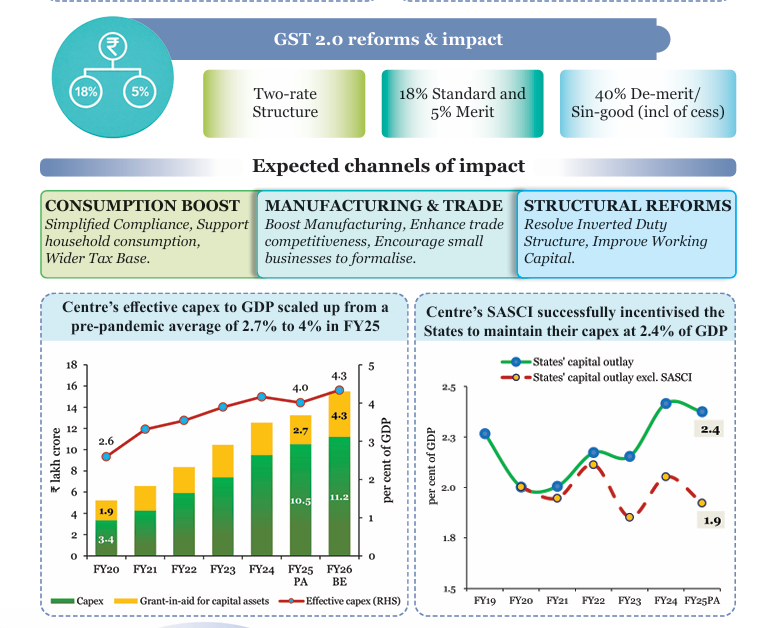
- From April to December 2025, gross goods and services tax (GST) receipts were Rs 17.4 lakh crore, an increase of 6.7% year over year. In order to increase consumption, improve compliance, and strengthen manufacturing competitiveness, GST 2.0 suggests a streamlined two-rate system.
- Even though India maintained strong public investment and lowered its general government debt-to-GDP ratio by about 7.1% points since 2020, state fiscal deficits increased marginally to 3.2% of GDP in FY25.
- Monetary Management & Financial Intermediation
- FY26 (April–December 2025) saw strong performance from India’s monetary and financial sectors.
- With gross non-performing assets (NPA) at 2.2% and net NPA at 0.5% in September 2025, the asset quality of the banking industry had improved. By December 2025, loan growth had increased to 14.5% YoY.
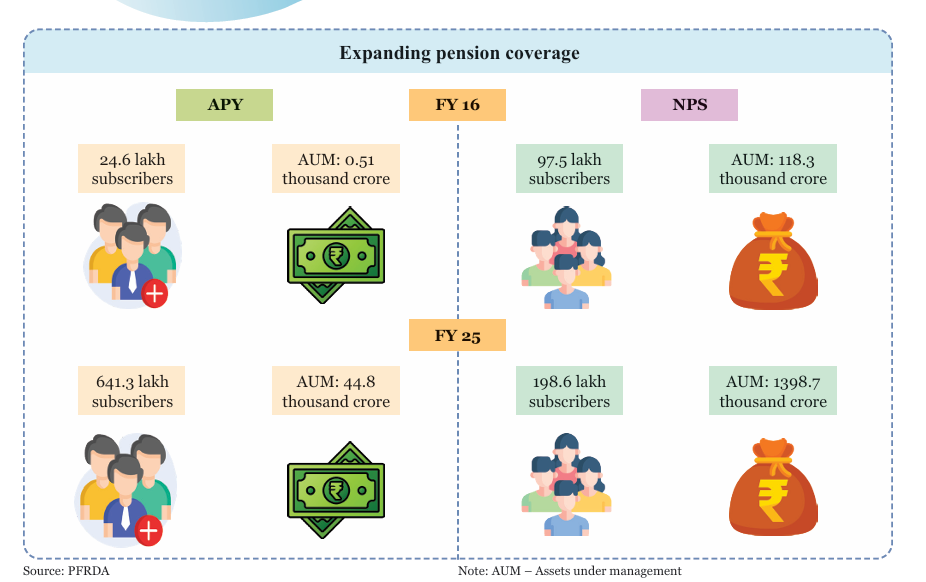
- In addition to increased credit availability through Stand-Up India, PM SVANidhi, and Pradhan Mantri Mudra Yojana (PMMY), which have disbursed Rs 36.18 lakh crore across 55.45 crore loan accounts, financial inclusion increased, with Pradhan Mantri Jan Dhan Yojana (PMJDY) accounts reaching 55.02 crore.
- With almost 21.6 crore demat accounts, 12 crore unique investors (nearly 25% of whom were women), and 5.9 crore mutual fund investors—many of whom were from non-metropolitan areas—capital market involvement skyrocketed.
- The IMF–World Bank Financial Sector Assessment Program (FSAP) 2025 validated regulatory quality globally and showed that the financial system is robust and well-capitalized, with total financial sector assets at about 187% of GDP and sufficient buffers even in the face of extreme stress.
- External Sector
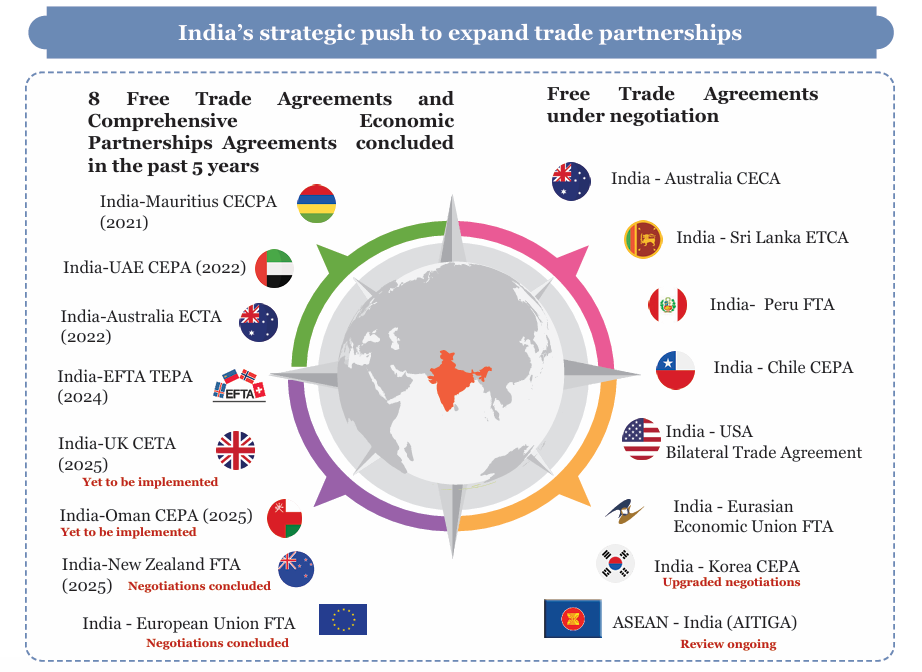
- Along with significant trade partner diversification, India’s external industry saw significant growth, increasing its share of global product exports from 1% to 1.8% and services exports from 2% to 4.3% between 2005 and 2024.
- With services exports reaching a record high of USD 387.6 billion (13.6% YoY growth), total exports reached a record USD 825.3 billion in FY25 (6.1% YoY growth).
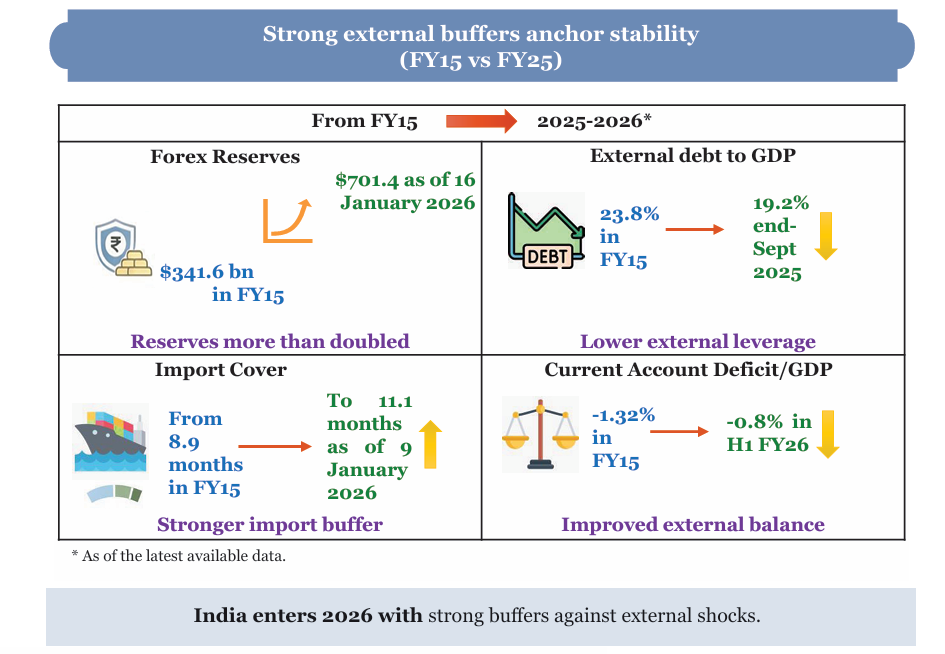
- Strong services and record remittances of USD 135.4 billion helped to keep the current account deficit (CAD) low (~1.3% of GDP in Q2 FY26), while forex reserves increased to USD 701.4 billion (11 months import cover).
- Inflation
- Food and fuel disinflation (52.7% of the CPI basket) was the primary driver of India’s lowest-ever Consumer Price Index (CPI) inflation, with average headline inflation of 1.7% from April to December 2025.
- India had one of the biggest drops in inflation among the major Emerging Markets & Developing Economies (EMDEs).
- Agriculture and Food Management
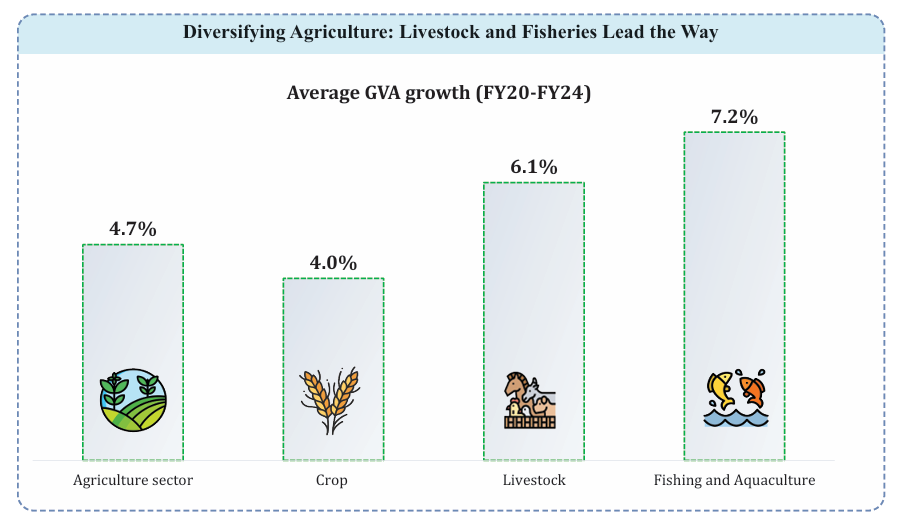
- With fish output expanding by more than 140% (2014–24) and livestock GVA increasing by almost 195% (FY15–FY24), India’s agriculture sector shown impressive growth.
- Foodgrain production hit a record 3,577.3 lakh metric tonnes (LMT) in AY 2024–2025 thanks to a strong monsoon, but horticulture—which accounts for 33% of agri-GVA—became a major growth engine and surpassed foodgrains.
- The Agriculture Infrastructure Fund (AIF), e-NAM, guaranteed MSP, PM-KISAN, and PM Kisan Maandhan Yojana (PMKMY) pension coverage all improved farm incomes and resilience by strengthening marketing and income support.
- Services
- The services sector continues to be the major beneficiary of foreign direct investment (FDI), accounting for almost 80% of total inflows in FY23–FY25. India is the seventh-largest exporter of services, with its worldwide share increasing from 2% (2005) to 4.3% (2024).
- With 30% of all occupations and 61.9% of positions in metropolitan areas, the services sector makes a substantial contribution to employment.
- With the growth of its worldwide Capability Centers (GCCs), India has solidified its standing as a worldwide center for innovation and technology.
- The nation is home to the third-largest technology startup ecosystem in the world, with GenAI startups growing quickly, a sign of the robust momentum in cutting-edge digital and innovation-driven industries.
- Industry’s Next Leap
- According to WIPO (2024), India has a growing innovation ecosystem, ranking 12th in the world for entrepreneurship policy and culture, 4th for trademarks, 6th for patents, and 7th for industrial designs.
- Additionally, it has made a significant advancement in essential technology, ranking in the top five worldwide in 45 of 64 critical technologies, a significant increase from just four in 2003–07.
- With India’s Global Innovation Index ranking rising from 81 (2015) to 38 (2025), the country’s innovation ecosystem has been continuously growing. By 2025, the number of DPIIT-recognized startups had increased to around 2 lakh.
- Between FY20 and FY25, patent applications almost quadrupled, indicating increased IP activity and innovation.
- Production Linked Initiative (PLI) programs created 12.6 lakh employment, brought in Rs 2.0 lakh crore in investment, and produced Rs 18.7 lakh crore in production.
- Investment and Infrastructure
- With government capital expenditure increasing 4.2 times from Rs 2.63 lakh crore (FY18) to Rs 11.21 lakh crore (FY26 BE) and effective capital expenditure reaching Rs 15.48 lakh crore (FY26 BE), India’s infrastructure drive has accelerated from FY18.
- With capacity reaching 509.74 GW and DISCOMs being profitable in FY25, the electricity sector continued to grow until November 2025.
- 5G services are currently accessible across 99.9% of the nation’s districts, and tele-density has reached 86.76%.
- Under the Jal Jeevan Mission, more over 81% of rural families had access to safe tap water as of October 2025.
- India became the fourth country to accomplish autonomous satellite docking (SpaDeX), strengthening space infrastructure.
- Environment and Climate Change
- As of December 2025, 30.16 GW of solar, 4.47 GW of wind, 3.24 GW of hydro, and 0.03 GW of biopower accounted for the majority of the 38.61 GW of new renewable capacity.
- The SHANTI Act 2025, which permits private involvement, supports the National Nuclear Energy Mission’s goal of having five domestically developed Small Modular Reactors (SMRs) online by 2033, increasing nuclear capacity from 8,780 MW to 100 GW by 2047.
- Action plans for the circular economy and PARIVESH 3.0 single-window approvals simplified environmental governance.
- Education and Health
- With a goal of 50% GER in higher education by 2035 and 100% GER in school education by 2030, India is moving closer to achieving universal access to education.
- The educational system records GERs of 90.9 (Grades I–V), 90.3 (VI–VIII), 78.7 (IX–X), and 58.4 (XI–XII) for around 25 crore students across 14.7 lakh schools, with over 1 crore instructors.
- The number of students enrolled in higher education has increased from 27.1 (2019–20) to 29.5 (2022–23), with 4.46 crore students.
- The National Education Policy, 2020-led changes, including the implementation of the National Credit Framework (NCrF), the Academic Bank of Credit with APAAR (Automated Permanent Academic Account Registry) IDs with credits, and flexible entry-exit paths in institutions, all contributed to the expansion of access to higher education.
- India’s maternal mortality rate (MMR) has decreased by 86% since 1990, while the under-five mortality rate (U5MR) has decreased by 78% and the newborn mortality rate (NMR) has decreased by 70%, both of which are better than the global averages.
- From 40 deaths per thousand live births in 2013 to 25 deaths per thousand in 2023, the infant mortality rate (IMR) decreased by more than 37%.
- Employment and Skill Development
- With total employment at 56.2 crore (15+ age group) in Q2 FY26, reflecting net job creation of around 8.7 lakh over Q1 FY26, India’s labor market remains robust, driven by economic development.
- While unemployment remained low at about 5% throughout Q1–Q2 of FY26, the labor force participation rate increased from about 55% in April to about 56.1% by December.
- Together with a dramatic drop in female unemployment from 5.6% to 3.2%, the female labor force participation rate increased from 23.3% (2017–18) to 41.7% (2023–24), showing more robust and inclusive labor market outcomes.
- Over 10 lakh jobs in organized manufacturing increased 6% year over year in FY24, and labor codes extended social security to gig and platform workers.
- The National Career Service linked 59 million job seekers with 5.3 million companies, mobilizing around 80 million openings, while e-Shram enrolled 31 crore unorganized workers, of which 54% were women.
- Rural Development and Social Progress
- According to the World Bank’s updated USD 3.0/day poverty level, extreme poverty decreased to 5.3% in 2022–2023. Tech-driven rural efforts like Namo Drone Didi, SVAMITVA (which maps 3.28 lakh villages and issues 2.76 crore property cards), and smart village models that use drones, solar electricity, and telemedicine have all contributed to this achievement.
- Samarth, Meri Panchayat, and eGramSwaraj are examples of participatory government systems that have enhanced local planning and monitoring. Infrastructure development has resulted in the construction of 2.9 crore homes, over 81% tap water coverage, and 99.6% rural connectivity.
- With more than 9 lakh community resource persons promoting women-led SHGs, food security, and steady rural incomes, DDU-GKY and DAY-NRLM enhanced livelihoods and skill development.
- Citing serious structural problems, the Survey defended the elimination of MGNREGS and emphasized the Viksit Bharat Guarantee for Rozgar and Ajeevika Mission (Gramin) Act, 2025, as a complete legislative overhaul.
- Evolution of the AI Ecosystem in India
- With top-notch research output, a sizable talent pool, the second-most AI-literate workforce in the world after the US, and a wealth of underutilized domestic data in important areas, India has solid AI foundations.
- The AI data architecture, which is based on India’s approximately 1 billion connected people, strikes a balance between transparency, supervision, and the production of value domestically through incentive-based compliance.
- In order to provide sector-specific AI solutions for India’s development requirements, it encourages upskilling, domestic R&D financing, and local model training.
- Urbanisation
- The Namo Bharat Regional Rapid Transit System (RRTS) demonstrates how high-speed regional connection fosters polycentric growth, reduce travel time, increases access to jobs, and relieves strain on big cities.
- Trash management significantly improved, with trash processing increasing from 16% (2014–15) to 80% (2024–25) and door-to-door MSW pickup reaching 98% of urban wards.
What are the Key Challenges Highlighted by the Economic Survey of India 2025-26?
- Global Uncertainty
- Access to vital minerals, energy, technology, and finance is becoming more uncertain due to a shift from rules-based globalization to geopolitical fragmentation, which is characterized by strategic trade, supply-chain weaponization, volatile capital flows, and growing resource nationalism (Pax Silica), according to the Survey.
- State Capacity as the Binding Constraint
- Mission-oriented governance is not India’s main problem; rather, it is bureaucratic risk aversion, a dread of vigilance investigations and retroactive audits, and the difficulty to undo transitory initiatives (policy hysteresis).
- Despite providing short-term respite, the Survey cautions that the fast rise of unconditional cash transfers (Rs 1.7 lakh crore in FY26) raises dangers to medium-term growth and fiscal sustainability.
- It warns that increasing transfers, particularly in states with income deficits, drive out profitable capital spending.
- Competitiveness Issues
- As an implicit tax on downstream production, high energy, transport, and raw material costs reduce exports.
- External resilience is limited since the rupee is still fundamentally weak and supported by capital inflows rather than steady export surpluses.
- Low R&D
- In contrast to productivity-driven global competition, the private sector places more emphasis on short-term profitability and regulatory control.
- The lack of corporate management of the nation’s productive capacity and underinvestment in R&D and frontier manufacturing limit long-term industrial capabilities.
What Policies Can Help India’s Economy Grow?
- Manufacturing Push: With PLI schemes supporting it, accelerate the shift to medium- and high-technology production, with particular vigor in electronics, electric vehicles, and medicines.
- Agriculture Reorientation: In order to increase productivity and sustainability, the survey identifies yield gaps compared to worldwide averages and advocates for improved seeds, crop diversity, enhanced extension services, FPO–PACS–SHG integration, and climate-resilient practices.
- Infrastructure-led Investment: Supported by the quick development of ports, railroads, highways, and logistics efficiency, maintain high public capital expenditures to attract private investment.
- Human Capital & Skilling: Using flexible, credit-based learning paths, PMKVY 4.0, apprenticeships, Skill Impact Bonds, and NEP-led vocationalization, match education and skills to industry demands.
- Energy Transition & Sustainability: Through EPR and waste action plans, scale battery energy storage, further the circular economy, and further the National Nuclear Energy Mission.
- Urban Transformation: To alleviate traffic and sprawl, boost FSI, fortify ULB funding, and extend public transportation (e.g., metros, e-buses) to unlock urban production.
- AI & Digital Strategy: Adopt a “Frugal AI” strategy that emphasizes application-specific AI and is backed by reliable cross-border data flows that preserve domestic value, making sure that Indian data boosts regional R&D and innovation.
- Climate Strategy: The Survey promotes a growth-aligned approach to climate change, seeing development as a crucial component of resilience and giving adaptation precedence over short-term mitigation.
- Mental Health: The survey highlights the dangers of digital addiction and screen-related mental health issues, particularly for kids, and advocates for preventative, school-based initiatives as well as the extension of Tele-MANAS beyond crisis intervention.
Conclusion
India is projected by the Economic Survey of India 2025-26 to go from “Strategic Resilience” to “Strategic Indispensability,” not just as a robust economy but also as a rising anchor in the global order. Even if the macroeconomic foundations are still strong, India’s progress toward development will depend on coordinating the goals of policy with its implementation to guarantee inclusive, long-lasting growth that is intricately linked to global value chains.
Frequently Asked Questions (FAQs)
What is the Economic Survey?
Ahead of the Union Budget, the Government of India’s main yearly report, the Economic Survey, examines the status of the economy, sectoral trends, obstacles, and opportunities.
Who prepares and presents the Economic Survey?
Under the direction of the Chief Economic Adviser (CEA), the Ministry of Finance’s Economic Division prepares it, and the Union Finance Minister presents it to Parliament.
When is the Economic Survey presented in Parliament?
Typically, both Houses of Parliament get it one day before to the Union Budget.
When was the Economic Survey first introduced?
Originally included in the Budget in 1950–51, the Survey was released as a stand-alone document in 1964.
Sources:
- https://www.indiabudget.gov.in/economicsurvey/
- https://www.pib.gov.in/economicsurvey/2026/en/index.aspx?reg=3&lang=2
- https://prsindia.org/policy/report-summaries/economic-survey-2025-26
- https://edge.mheducation.co.in/blog/economic-survey-202526-indias-transition-from-growth-to-strategic-strength
- https://www.thehindu.com/business/budget/highlights-of-economic-survey-2025-26/article70564629.ece
- https://timesofindia.indiatimes.com/business/india-business/economic-survey-2025-26-key-highlights-gdp-growth-pegged-at-7-4-inflation-at-historic-lows-banks-and-exports-strengthen-amid-tariffs/articleshow/127771365.cms
- https://economictimes.indiatimes.com/news/budget-faqs/budget-2025-what-is-economic-survey-and-when-is-it-presented/articleshow/116314102.cms?from=mdr
Leave a Reply