Fiscal Health Index, 2026
Introduction
The second edition of the Fiscal Health Index (FHI) 2026 was published by NITI Aayog to assess the fiscal performance of Indian states. The index offers a data-driven framework to analyze state budgets, evaluate fiscal sustainability, and direct changes.
What is the Fiscal Health Index?
- NITI Aayog created the FHI, a thorough framework for evaluating and contrasting the fiscal performance of Indian states.
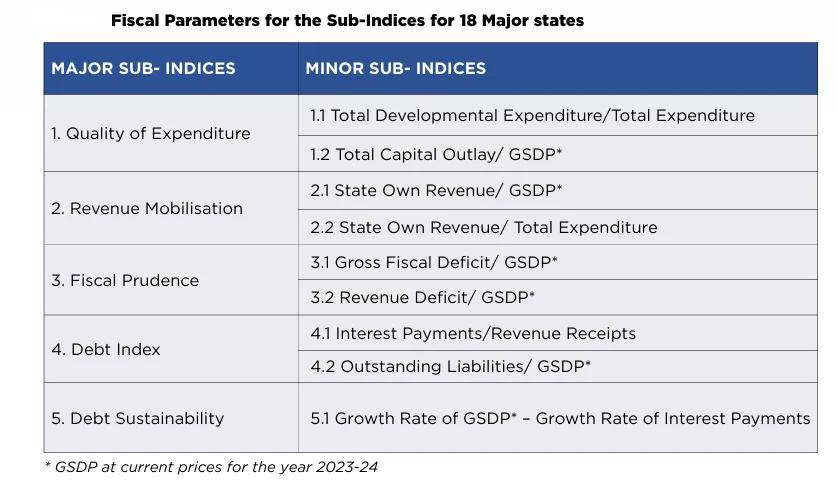
- Quality of Expenditure, Revenue Mobilization, Fiscal Prudence, Debt Index, and Debt Sustainability are the five main pillars that it uses to assess states.
- The Comptroller and Auditor General (CAG) has reviewed the data included in the index, guaranteeing accuracy and openness.
- The objective is to facilitate peer benchmarking across states, promote evidence-based policymaking, and direct improvements.
What is the Fiscal Health Index 2026?
- It provides a longitudinal view of how states are moving forward or backward by analyzing budgetary patterns over ten years, from FY 2014–15 to FY 2023–24.
- The index is now more inclusive of India’s varied fiscal environment, thanks to the second edition’s expansion of coverage from 18 General Category States to 10 North-Eastern and Himalayan States.
- In order to account for the particular difficulties faced by Northeastern states, such as their remote location, low population density, restricted own-revenue capacity, high committed expenditures, and increased reliance on Union transfers, sub-indicators have been developed.
- To achieve a fair and contextually suitable comparison, states in the Northeast and the Himalayas are rated differently from states in the general category.
- The edition enhances the depth of story insights and trend analysis while maintaining the same five foundations for large states.
What are the Highlights of the FHI 2026?
18 Major States
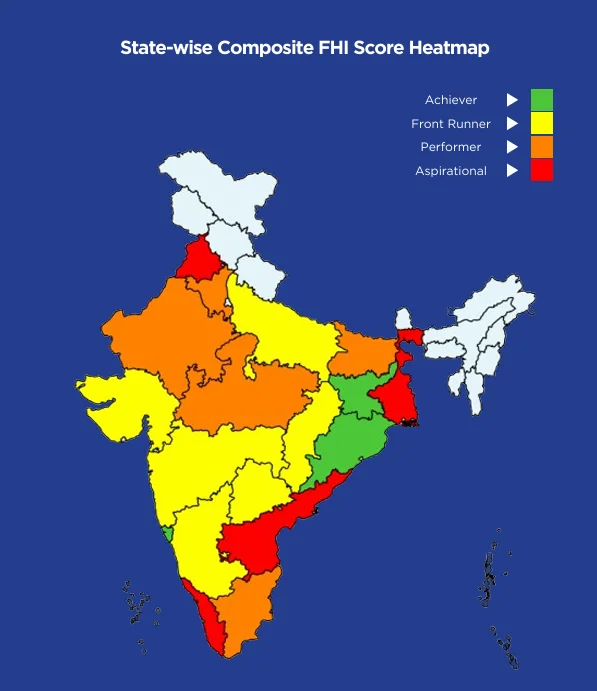
- Achievers (Top Performers)
- Odisha is still at the top of the rankings thanks to consistent earnings, reduced deficits, and rising scores every year.
- Achiever states are similar in that they have own-tax shares greater than 60%, capital expenditures between 4 and 5 percent of GDP, fiscal deficits less than 3 percent of GDP, moderate debt levels less than 25 percent of GDP, and controlled interest costs.
- High State Own Revenue ratios in Goa and Odisha are indicative of robust revenue bases and increased fiscal independence.
- Front-Runners
- Telangana, Uttar Pradesh, Karnataka, Gujarat, Maharashtra, and Chhattisgarh.
- Gujarat and Maharashtra promote fiscal sustainability by keeping debt levels low and interest loads under control.
- Performers
- Tamil Nadu, Rajasthan, Bihar, Madhya Pradesh, and Haryana.
- Bihar’s transition from Aspirational to Performer indicates improved deficit management.
- Telangana and Karnataka went from Front Runner to Performer, indicating a small fiscal slippage.
- Tamil Nadu’s decline from Performer to Aspirational indicates new financial strains.
- Aspirational (Bottom Performers)
- Andhra Pradesh, Punjab, West Bengal, and Kerala.
- These states frequently violate FRBM (Fiscal Responsibility and Budget Management) guidelines due to their ongoing revenue and budget deficits.
- Debt levels are far higher than the national comfort zone, ranging from about 35 to 45% of GSDP.
- There is minimal space for developmental spending since committed expenditures make up between 50 and 60 percent of revenue sources.
- Fiscal flexibility is further compressed when interest payments surpass 15–20% of revenue sources.
- Out of all the main states, Punjab, Kerala, and West Bengal have the highest debt and interest obligations.
North-Eastern and Himalayan States
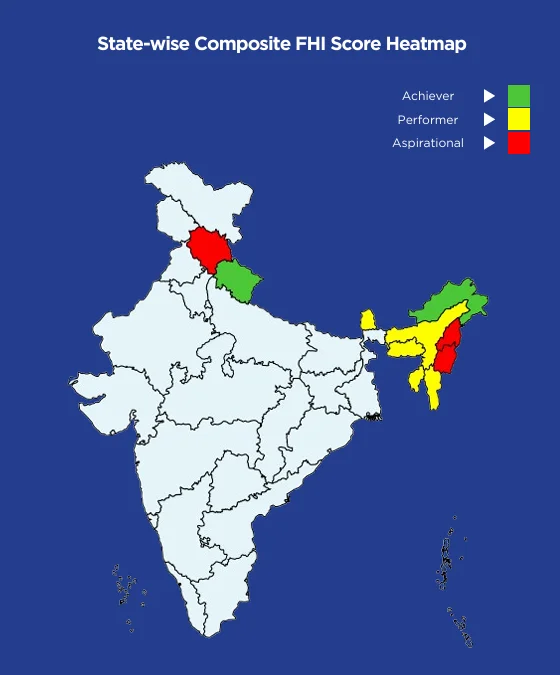
- Achievers
- Uttarakhand and Arunachal Pradesh.
- Because of its excellent spending quality, careful debt management, managed deficits, and sporadic fiscal surpluses, Arunachal Pradesh comes in first.
- Because of its comparatively larger own-revenue mobilization, which gives it more budgetary autonomy, Uttarakhand does well.
- Performers
- Tripura, Sikkim, Meghalaya, Assam, and Mizoram.
- In terms of debt sustainability, Tripura does well, while Mizoram struggles since its debt sustainability metrics are worse.
- Nagaland suffers from poor income mobilization and spending quality, whereas Sikkim performs worse in terms of fiscal restraint.
- Aspirational
- Manipur, Nagaland, and Himachal Pradesh.
- Due to their limited income bases, large committed expenditures (pensions and wages), and ongoing deficits, Himachal Pradesh and Manipur continue to be near the bottom.
- Their large debt levels—roughly 40–50% of GSDP—limit their budgetary flexibility and increase debt-servicing pressures.
What Does State Fiscal Health Matter?
- Macroeconomic Stability of India
- Since states make up almost one-third of India’s total government debt, their fiscal standing is essential to the country’s long-term financial viability.
- Fiscal strain on states can lead to inflationary pressures, discourage private investment, and compel the federal government to intervene with bailouts, thus destabilizing the economy as a whole.
- India’s total public debt is around 82% of GDP. States must manage their finances responsibly in order to keep the debt load under control.
- Large Role in Public Spending and Development
- State governments invest a significant portion of its budget on welfare, infrastructure, health, and education initiatives that have a direct impact on the development and well-being of their constituents.
- Strong fiscal health enables governments to increase capital expenditures, which promotes long-term economic growth and lessens regional inequities.
- Rising Debt and Fiscal Pressures
- States’ debt-to-GSDP ratio rose from over 16.7% in 2013–14 to almost 23% in 2022–2023, a sign of growing borrowing pressure.
- In FY25, the combined state budget deficit rose to almost 3.2% of GDP, indicating mounting financial strain on state governments that, if not handled correctly, might jeopardize fiscal viability.
Which Policy Measures to Strengthen State Finances Are Suggested by the FHI 2026?
- Boost Revenue
- Increase tax compliance, increase the GST tax base, and bolster the state’s own-tax income from stamp fees, excise taxes, and property taxes. To lower tax evasion, enhance data analytics, and digital tax administration.
- Control Spending
- Restore budgetary flexibility by reducing “committed expenditures” (such as large pension and salary bills) and rationalizing subsidies.
- The 16th Finance Commission (2026–31) recommended rationalizing subsidies, especially unconditional cash transfers, which make up over 20.2% of all subsidy expenditures.
- Improve Capital Outlay
- To promote long-term growth, concentrate on enhancing the quantity and caliber of capital expenditures.
- Plan for the Future
- Maintain the state budget deficit at about 3% of GSDP to meet FRBM goals.
- In order to preserve fiscal restraint and sustainable debt levels, the 16th Finance Commission (2026–31) also suggested lowering the Center’s budget deficit to 3.5% of GDP by 2030–31.
- Enhance Transparency
- For improved public financial management, tighten restrictions on off-budget borrowing, enhance cash management, and make use of verified CAG data.
Conclusion
The Fiscal Health Index 2026 emphasizes how important sound state finances are to the macroeconomic stability of India. To achieve the objective of Viksit Bharat @2047, states may use this benchmarking tool to detect fiscal deficiencies, implement targeted reforms, lessen regional inequities, and enhance fiscal governance.
Frequently Asked Questions (FAQs)
What is the Fiscal Health Index (FHI)?
NITI Aayog created the FHI, a framework for evaluating and contrasting the fiscal performance of Indian states using metrics including debt sustainability, revenue mobilization, spending quality, and fiscal prudence.
The Fiscal Health Index uses which pillars to assess states?
Quality of Expenditure, Revenue Mobilization, Fiscal Prudence, Debt Index, and Debt Sustainability are the five pillars on which the index assesses states.
According to the Fiscal Health Index 2026, which states are performing the best?
Odisha, Goa, and Jharkhand are considered Achievers among the main states because of their modest debt levels, minimal budget deficits, and robust revenue mobilization.
Why are the Himalayan and Northeastern states graded differently in FHI 2026?
Due to structural limitations such challenging terrain, sparse populations, low revenue capacity, and greater service delivery costs, context-specific assessment is necessary.
Sources:
- https://niti.gov.in/sites/default/files/2026-03/Fiscal-Health-Index-2026.pdf
- https://www.pib.gov.in/PressReleasePage.aspx?PRID=2238302®=3&lang=1
- https://indianexpress.com/article/trending/top-10-listing/fiscal-health-index-2026-top-10-best-states-india-10585956/
- https://timesofindia.indiatimes.com/city/chennai/tamil-nadu-fiscal-health-niti-aayog-report-reveals-surprising-rankings/articleshow/129737100.cms
- https://www.gktoday.in/niti-aayog-releases-fiscal-health-index-2026-for-indian-states/
Leave a Reply