Safeguarding The Aravalli Hills, 2025
Introduction
A uniform definition of the Aravalli Hills as hills 100 meters or higher above local ground was adopted by the Supreme Court (SC) of India in November 2025, raising concerns that this could weaken the range’s legal protection and expose a significant portion of it to mining and construction activities.
What was decided by the Indian Supreme Court on the New Aravalli Hills?
- About Aravalli New Definition
- In order to control mining and safeguard the environment, a committee within the Ministry of Environment, Forests, and Climate Change (MoEF&CC) suggested a consistent, scientific definition of the Aravalli Hills and Ranges, which was approved by the Supreme Court.
- Protected areas, eco-sensitive zones, tiger reserves, and wetlands are examples of core/inviolate areas where mining is prohibited by the Supreme Court. Only atomic minerals (Part B of the First Schedule), critical and strategic minerals (Part D), and minerals listed in the Seventh Schedule of the MMDR Act, 1957 are exempt.
- Aravalli Hills
- Any landform that rises at least 100 meters above the surrounding local topography is defined as such.
- The lowest contour line surrounding the landform is used to calculate the local relief.
- Regardless of height, the entire hill system—including supporting slopes and related landforms—is protected.
- Aravalli Ranges
- Described as groups of two or more of these hills that are 500 meters or less apart. The range encompasses all of the space between these hills, including slopes and minor hillocks.
- This term was intended to bring impartiality and clarity to the regulation of activities such as mining throughout the Aravalli environment.
- Supreme Court Directions
- Additionally, until the Indian Council of Forestry Research and Education (ICFRE) prepares a Management Plan for Sustainable Mining (MPSM), the Court ordered a temporary ban on granting new mining leases in areas falling under this definition.
- No-mining zones, severely regulated mining regions, wildlife corridors, sensitive habitats, carrying capacity, cumulative ecological consequences, and restoration and rehabilitation strategies must all be identified in the plan.
- The Court adopted a measured approach, putting a halt to new mining, protecting ecologically vulnerable areas permanently, and strictly regulating existing legal mining since it recognized that broad prohibitions can encourage illicit mining.
What are the Criticisms Regarding the New Definition of Aravalli Hills?
- Exclusion of Majority Landscape: Over 90% of the Aravalli system is excluded from the new definition by the 100-meter barrier, according to an internal Forest Survey of India (FSI) study.
- Threat of Expanded Mining: Decades of conservation efforts could be undone by mining, development, and urban growth in areas that don’t fit the description.
- Ignoring Ecological Continuity: Although the term is thought to be peak-centric and ignores the biological significance of foothills, valleys, and connecting ridges, the Aravallis work as a continuous ecological system.
- Risk to Groundwater Recharge: Water tables in Rajasthan, Haryana, Gujarat, and Delhi-NCR could drop if lower hills and slopes are disturbed since they are essential for rainwater percolation and aquifer recharging.
- Accelerated Desertification: India’s duties under the UN Convention to Combat Desertification could be undermined if the Aravalli barrier is weakened, allowing the Thar Desert to spread eastward and worsen dust storms, soil degradation, and aridity.
- Implementation and Enforcement Challenges: The new definition may lead to regulatory gaps that make it more difficult to stop illicit mining in the absence of thorough mapping and stringent oversight.
What are the Key Facts About Aravalli Hills Range?
- Geological Origin and Evolution
- The Aravalli Range, which dates back around 2,000 million years to the Precambrian age, is one of the oldest mountain ranges in the world and the oldest in India.
- It was created by tectonic plate collisions during the Aravalli–Delhi orogeny. Over millions of years, weathering and erosion diminished the size of a much bigger prehistoric mountain chain, leaving behind the severely eroded Aravallis of today.
- The highest point in the Aravalli Range is Guru Shikhar point on Mount Abu (1,722 m).
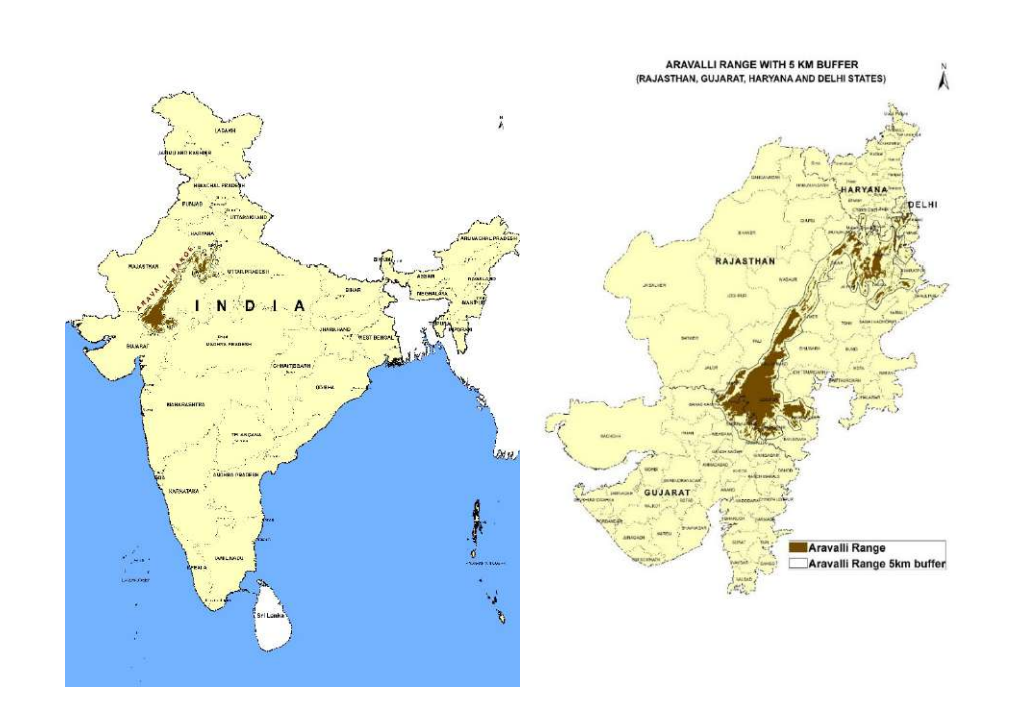
- It travels more than 800 kilometers (via Rajasthan and Haryana) from Gujarat to Delhi.
- Climatic and Ecological Importance
- The Aravallis serves as a natural defense against the spread of the Thar Desert into northwest India.
- Numerous gaps caused by deforestation and degradation have made it possible for desert sand to move toward fertile plains, exacerbating dust storms and air pollution.
- Biodiversity and Wildlife Significance
- With a distinctive blend of Saharan, Peninsular, and Oriental biodiversity, the Aravalli region is home to dry deciduous forests, grasslands, and wetlands.
- In addition to providing habitat for endangered species including the tiger, leopard, Indian wolf, sloth bear, and Great Indian Bustard, it is home to 22 wildlife sanctuaries and three tiger reserves.
- Agriculture, Livelihoods, and Livestock
- Bajra, maize, wheat, mustard, and pulses are used in the Aravalli region’s rainfed, subsistence-based agriculture. The health of the ecosystem is essential to rural livelihoods due to the region’s heavy reliance on livestock and forest resources.
- Economic and Mineral Importance
- More than 70 commercially valuable minerals, such as zinc, lead, silver, tungsten, marble, and granite, can be found in the Aravalli region.
- In Rajasthan, which makes up around 80% of the range, mining has become a significant economic sector.
- Industrial Development and Urban Pressure
- The Aravalli belt is home to important industrial and urban clusters including Gurugram, Faridabad, Jaipur, Alwar, and Ajmer because of its advantageous location.
- It helps a variety of industries, including steel, chemicals, autos, textiles, and IT.
- Cultural and Heritage Significance
- Forts like Chittorgarh and Kumbhalgarh are UNESCO World Heritage Sites located in the Aravalli range.
- Major religious sites like Pushkar, Ajmer Sharif, Mount Abu, and Ranakpur are located there as well, making it sacred to Jain, Islamic, and Hindu traditions and enhancing its cultural significance.
- Degradation and Environmental Decline
- The Aravallis have seen significant grazing pressure, mining, urbanization, and deforestation throughout the years.
- Rainfall duration has drastically decreased, forest cover has drastically decreased, and several hills have entirely vanished.
- Particularly affecting Delhi-NCR, these changes have led to soil erosion, aquifer damage, desert gap extension, and worsening air pollution.
What Steps Are Needed to Increase Aravalli Hills Range Protection?
- Scientific Identification and Mapping
- Using reliable datasets, map hills, ranges, slopes, valleys, recharge zones, and wildlife corridors thoroughly and consistently.
- Implement risk-based, graded controls on mining operations that are backed by precise standards for monitoring, regulation, and ban.
- Prevention of Illegal Mining
- Use technology-based techniques and institutional collaboration to improve monitoring, surveillance, and enforcement processes.
- To stop illicit mining and sand mafias, use drones, satellite photography, CCTV, e-challans, and district task groups.
- Ecosystem restoration and management
- Encourage the restoration of mined areas, degraded forests, and grasslands based on long-term sustainability and ecological compatibility.
- In Aravalli communities, indigenous techniques like taankas, jhalaras, and talab-bandis improve watershed management.
- Wind Erosion & Sand Drift Control
- Sand dunes were stabilized and wind erosion was decreased by surface vegetation that used species like Calligonum and Acacia.
- In the Aravalli Gap regions, it aids in the management of dust storms and desertification.
- Restoration and Global Commitments
- The New Delhi Declaration (UNCCD CoP-14) emphasizes sustainable land management and emphasizes how desertification threatens development and livelihoods.
- In order to achieve India’s obligations under the Paris Agreement, the Bonn Challenge, and Land Degradation Neutrality, as well as to conserve water regulation, biodiversity, and climate resilience while preserving local livelihoods, the Aravalli ecosystem must be restored.
Conclusion
The Aravalli Hills Range serves as northwest India’s life support system in addition to being a geological element. Both livelihoods and climate stability are at risk due to its degradation. Therefore, conservation and restoration of the Aravallis are ecological, economic, and civilizational imperatives that call for community-based restoration as well as landscape-level protection.
Frequently Asked Questions (FAQs)
What did the Supreme Court of India decide on the Aravalli Hills in 2025?
The Court ordered the creation of a Management Plan for Sustainable Mining (MPSM), put a halt to new mining leases, and established a consistent, scientific description of the Aravalli Hills and Ranges.
How are Aravalli Hills defined under the Supreme Court–approved framework?
Landforms rising 100 meters or more above local relief are referred to the Aravalli Hills, and the entire hill system—including supporting slopes and enclosed landforms—is protected.
What constitutes an Aravalli Range under the new definition?
When two or more Aravalli Hills are within 500 meters of one another, they are considered to be part of the same range, and the entire land in between is protected.
What is the Aravalli Green Wall Initiative?
The Aravalli range and its buffer zones in Gujarat, Rajasthan, Haryana, and Delhi are included in this MoEF&CC-led landscape restoration effort, which aims to stop desertification and land degradation.
Sources:
- https://www.pib.gov.in/FactsheetDetails.aspx?id=150596&NoteId=150596&ModuleId=16®=3&lang=2#:~:text=In%20its%20final%20judgment%20dated,in%20Aravali%20Hills%20and%20Ranges%20(
- https://www.thehindu.com/news/national/centre-rejects-mining-push-charge-behind-aravalli-definition/article70422874.ece
- https://timesofindia.indiatimes.com/india/no-new-mining-permitted-environment-minister-clarifies-amid-aravalli-uproar-defends-new-definition/articleshow/126121558.cms
- https://www.ndtv.com/india-news/new-rules-threaten-aravalli-range-90-hills-may-lose-protection-9764178
- https://moef.gov.in/uploads/pdf-uploads/pdf_682f0a92983b08Wall.pdf
- https://economictimes.indiatimes.com/news/new-updates/save-aravalli-campaign-floods-x-why-has-the-supreme-courts-ruling-on-aravallis-mountain-range-triggered-an-alarm-and-why-experts-call-it-death-warrant-explained/articleshow/126088733.cms?from=mdr
- https://www.hindustantimes.com/india-news/why-has-the-new-definition-of-the-aravalli-hills-triggered-a-protest-what-activists-say-101766282181567.html
Leave a Reply