SC Approves Harish Rana First Passive Euthanasia Case, 2026
Introduction
In the Harish Rana vs. Union of India Case (2026), the Supreme Court (SC) made the first application of the 2018 Common Cause ruling, acknowledging the right to die with dignity by permitting passive euthanasia through the removal of life support.
What are the Key Observations of the Supreme Court in Harish Rana Case 2026?
About the Case
- In August 2013, 19-year-old Chandigarh student Harish Rana fell from a fourth-floor building. He was in a Permanent Vegetative State (PVS) with 100% quadriplegia (paralysis of all four limbs) as a result of the accident’s devastating brain damage.
- He received only Clinically Assisted Nutrition and Hydration (CANH) through surgically implanted PEG tubes for over 13 years, and he showed no signs of recovery. The family petitioned the Supreme Court, which ultimately approved passive euthanasia, after the Delhi High Court rejected their father’s claim in 2024.
Key Observations of SC
- Acceptance of Medical Boards’ Recommendations
- The Supreme Court ordered All India Institute of Medical Sciences, Delhi, to admit Harish Rana to its palliative care section and create a “strong, palliative, and end-of-life care plan” after accepting the unanimous decision of medical boards and family members to remove life support.
- It stressed that withdrawal does not equate to “abandonment” of the patient and that it must be done humanely, controlling discomfort and symptoms to protect the patient’s dignity.
- Status of Clinically Administered Nutrition (CAN)
- According to SC, administering Clinically Administered Nutrition (CAN) using PEG (percutaneous endoscopic gastrostomy) tubes qualifies as “medical therapy” rather than just basic care.
- Therefore, if it is not in the patient’s best interest, the medical boards may allow its removal, which comes under the category of passive euthanasia.
- Waiver of Reconsideration Period
- The SC expedited the medical boards’ decision to remove CAN by waiving the customary 30-day review process in order to save needless suffering.
Procedural Directives for Future Cases
- Streamlining Process
- All Judicial Magistrates must be instructed by High Courts to accept and handle hospital notifications about medical board rulings on passive euthanasia.
- In order for Chief Medical Officers (CMOs) to serve on Secondary Medical Boards, the Union Government of India is required to maintain a panel of registered medical practitioners in each district.
- Need for Comprehensive Legislation
- The Supreme Court recommended that the Union Government pass a comprehensive end-of-life care law.
- It cautioned that in the absence of such regulation, judgments are susceptible to unrelated elements that might unlawfully influence results, such as financial hardship, a lack of insurance, or socioeconomic vulnerability.
What is Euthanasia?
- About
- Euthanasia is the purposeful, intentional act of taking a person’s life to stop their excruciating, ongoing suffering brought on by a fatal or incurable disease, an irreversible coma, or a persistent vegetative state.
- The phrase, which has Greek origins and means “good death” (eu for good and thanatos for death), is frequently used to describe acts of charity intended to maintain dignity in the last moments of life.
- Classifications
- It may be broadly categorized into two types: passive euthanasia, which involves withholding or withdrawing life-sustaining medical care to enable natural death to occur, and active euthanasia, which involves a purposeful act, such as a deadly injection, to cause death. Consent divides these further:
- Voluntary: Done with the patient’s express permission.
- Non-voluntary: When a patient is unable to provide permission, such as in a coma.
- Involuntary: Generally prohibited, carried performed without the patient’s permission.
- It may be broadly categorized into two types: passive euthanasia, which involves withholding or withdrawing life-sustaining medical care to enable natural death to occur, and active euthanasia, which involves a purposeful act, such as a deadly injection, to cause death. Consent divides these further:
- Statutory Framework
- There is a major difference between active and passive euthanasia under Indian law.
- The Bharatiya Nyaya Sanhita (BNS), 2023, which treats willfully inflicting death as a crime under Section 100 (culpable homicide) or Section 101 (murder), nevertheless expressly forbids active euthanasia.
- In the Common Cause v. Union of India (2018) case, however, the Supreme Court recognized the right to die with dignity as an essential component of Article 21 (Right to Life), therefore legalizing passive euthanasia.
- The 241st Law Commission of India Report also made it clear that doctors who comply with a competent patient’s request to refuse life-sustaining care are not liable for abetment or culpable murder.
- Judgments Shaping Euthanasia in India
- In Maruti Shripati Dubal v. State of Maharashtra (1987), the Bombay High Court decided that people who are terminally ill or in excruciating pain have the inherent right to die under Article 21 (Right to Life).
- In Gian Kaur v. State of Punjab (1996), the Supreme Court overturned the previous decision, emphasizing the preservation of life and holding that the right to life does not include the right to die.
- In the landmark case of Aruna Shanbaug v. Union of India (2011), the Supreme Court allowed passive euthanasia under stringent legal and medical protections, including for patients who were incapable of giving their permission.
- In Common Cause v. Union of India (2018), the Supreme Court upheld the right to a dignified death, made a distinction between active and passive euthanasia, and acknowledged living wills as legally recognized advance medical directives.
- Legal Process for Passive Euthanasia
- The Supreme Court amended the 2018 Common Cause guidelines in 2023 to create a two-phase medical evaluation procedure for passive euthanasia:
- The treating physician and two independent physicians with at least five years of experience (down from twenty years) make up the Primary Medical Board, which is established by the hospital.
- The District Medical Officer maintains a panel of three independent physicians who make up the Secondary Medical Board. They evaluate the first board’s decisions.
- The Judicial Magistrate First Class (JMFC) must be informed of the decision to stop treatment by both boards, ideally within 48 hours, and the patient’s family or guardian must provide their approval.
- Global Perspectives on Euthanasia
- The Netherlands permits both assisted suicide and active euthanasia, Switzerland only permits assisted suicide, while Italy permits passive euthanasia.
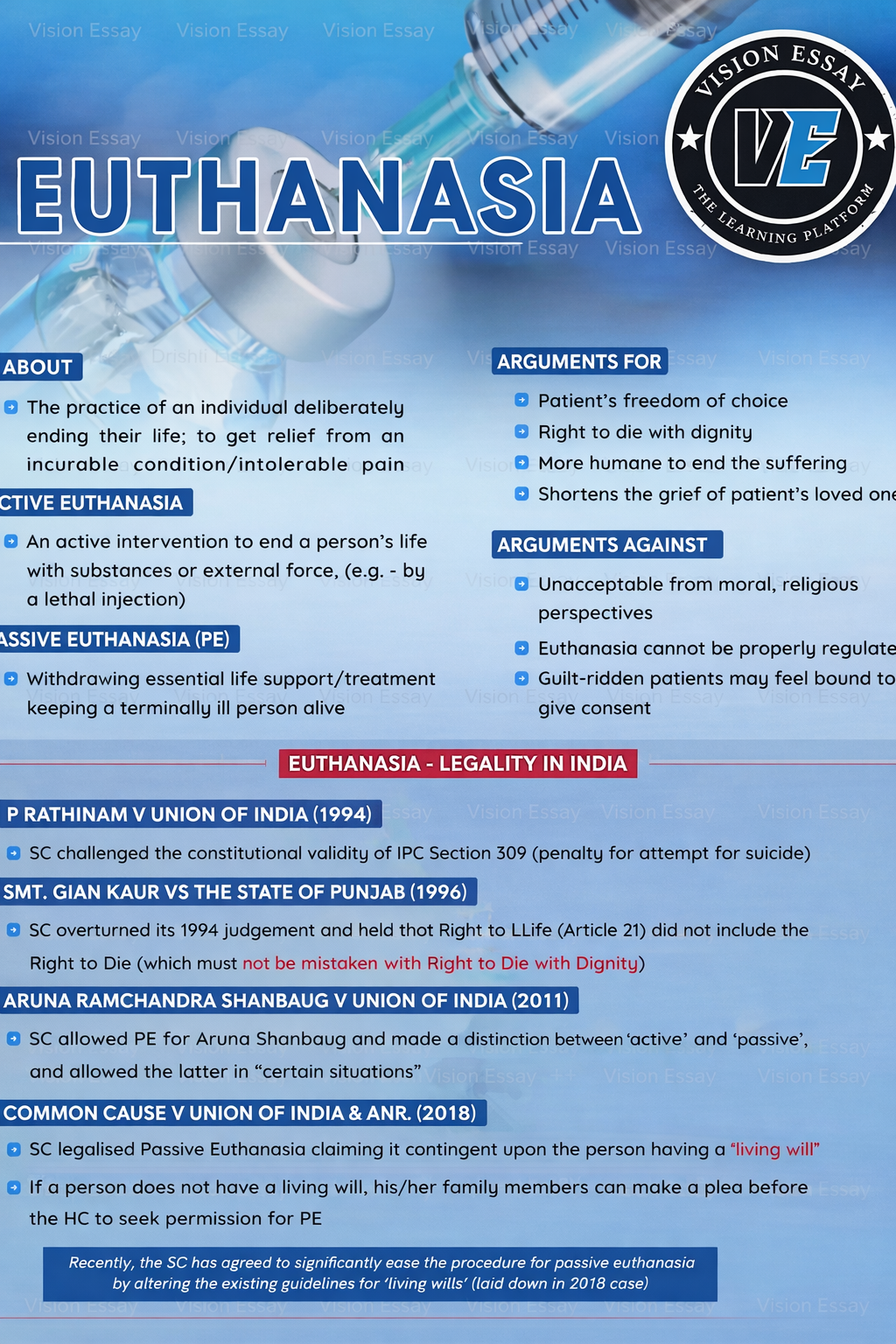
What are the Arguments For and Against Legalizing Euthanasia?
| Category | Favor of Legalization | Against Legalization |
|---|---|---|
| Autonomy & Rights | People have a basic right to self-determination, which includes choice over their bodies and how and when they pass away. Denying this violates one’s dignity and right to personal freedom. | There is no acknowledged “right to be killed”; the right to life, which is safeguarded by human rights frameworks and constitutions, does not include the ability to demand that someone intentionally end one’s life. |
| Compassion & Suffering | Euthanasia offers a compassionate conclusion in situations of terminal disease, avoiding protracted suffering and enabling a respectable demise. | The majority of suffering may be effectively alleviated by modern palliative care and pain management; when high-quality end-of-life care is accessible and adequately supported, euthanasia is not essential. |
| Dignity & Quality of Life | Euthanasia allows for a deliberate, peaceful termination rather than forced endurance; prolonging life without significant quality can be harsh. | Regardless of perceived quality, human life has inherent value; legalizing euthanasia runs the danger of discounting the lives of the aged, handicapped, and chronically sick by suggesting that certain lives are “not worth living.” |
| Regulation & Safeguards | Euthanasia may be safely controlled with stringent requirements (such as terminal disease, competent permission, and numerous medical views), as shown in countries like Canada, the Netherlands, Belgium, and India. | A “slippery slope” is evident from experience in liberal jurisdictions. Non-terminal ailments and mental illnesses that result in involuntary or non-voluntary cases may be eligible in addition to terminal instances. |
| Burden on Others | Lessens the emotional and financial stress on loved ones and enables patients to avoid burdening family or society with long-term care. | Legalization may conceal coercion or insufficient assistance by increasing pressure on vulnerable people to choose suicide because they feel like a “burden” (e.g., growing percentages in Oregon, USA highlight this issue). |
| Medical Profession | Complies with doctors’ obligation to alleviate suffering; in situations where there is no chance of recovery, taking a patient’s life humanely performs a larger therapeutic function. | Undermines patient trust and professional integrity by going against fundamental medical principles (such as the Hippocratic Oath’s “do no harm”) and the doctor’s position as a healer and life preserver. |
How Can India Improve the Support Network for Patients Who Are Near Death?
- Establish a National Palliative Care Mission
- The National Health Mission 2013 should serve as the blueprint for a special National Palliative Care Mission that will train medical personnel and establish pain management clinics.
- Make sure every district has access to necessary medications like oral morphine, which can treat severe, chronic, or cancer-related pain.
- Integrated Public Health Systems
- From Primary Health Centers (PHCs) to district hospitals, palliative care must be coordinated with initiatives like Ayushman Bharat, the National Programme for Non-Communicable Diseases 2010, and the National Programme for Health Care of the Elderly 2010.
- Legal Literacy and Living Wills
- Campaigns to raise public knowledge about Advanced Directives (Living Wills) are necessary.
- Hospitals should hire qualified “patient advocates” to talk to families about end-of-life preferences.
- Strengthen Family and Community Support Systems
- A thorough “Caregiver Support” approach has to offer families psychiatric counseling, home care training, and respite care services.
- Training local volunteers and recreating the Kerala-based Neighbourhood Network in Palliative Care (which offers home-based care for the terminally sick and dying) are two ways to revitalize community-based care.
- Ensure Financial Protection
- In order to lower catastrophic health expenditures, outpatient, home-based, and hospice palliative care must be completely integrated into the Ayushman Vay Vandana Scheme and the Pradhan Mantri Jan Arogya Yojana (PM-JAY) for elderly adults. This care should include critical drugs, symptom management, and caregiver support.
- Leverage Technology
- Ayushman Arogya Mandirs should use digital technologies to provide tele-palliative care services to rural regions.
- Data from the Pradhan Mantri Ayushman Bharat Health Infrastructure Mission must be used to enable robust monitoring systems that track patient outcomes and opioid availability.
Conclusion
A considerate development of Indian law on end-of-life care may be seen in the Harish Rana case of 2026. The Supreme Court correctly stressed the need to create a palliative care support system while legally allowing passive euthanasia under stringent limits. To guarantee that every person dies with dignity, comprehensive legislation, simplified processes, and universal access to pain treatment are necessary.
Frequently Asked Questions (FAQs)
In the Harish Rana Case (2026), what decision did the Supreme Court make?
The Supreme Court upheld the right to die with dignity under Article 21 by permitting passive euthanasia through the cessation of Clinically Administered Nutrition (CAN) following medical board permission.
What did the Common Cause v. Union of India (2018) ruling mean?
It created standards for passive euthanasia in India, certified living wills (advance medical directives), and legally acknowledged the right to die with dignity.
What does palliative care entail?
Palliative care is specialist medical treatment that aims to enhance patients’ and their families’ quality of life by easing the pain, symptoms, and stress associated with a serious disease.
Sources:
- https://api.sci.gov.in/supremecourt/2025/60980/60980_2025_7_1501_69246_Judgement_11-Mar-2026.pdf
- https://www.bbc.com/news/articles/c62v64rz6mko
- https://www.thehindu.com/news/national/why-did-the-sc-allow-passive-euthanasia-explained/article70744584.ece
- https://indianexpress.com/article/explained/explained-law/supreme-court-passive-euthanasia-ruling-explained-10577099/
- https://timesofindia.indiatimes.com/india/supreme-court-allows-withdrawal-of-life-support-in-harish-rana-passive-euthanasia-case/articleshow/129439934.cms
Leave a Reply