The Groundwater Crisis in India, 2026
Introduction
The Groundwater Crisis in India has emerged as one of the most serious environmental and socio-economic challenges in recent decades. India is the largest user of groundwater in the world, accounting for nearly 25% of global groundwater extraction. This excessive dependence has led to a rapid decline in water tables across many regions, creating a situation that threatens agriculture, drinking water supply, and long-term sustainability.
What are the Facts regarding the Groundwater Crisis in India?
- About: Nearly 99% of the freshwater on Earth is groundwater, which is freshwater kept in subterranean strata known as aquifers. It can arise spontaneously, seep into the earth, and be retrieved by wells.
- Groundwater Dependency: Groundwater provides roughly 62% of irrigation demands, 85% of rural consumption, and 50% of urban demand in India, making it the main source of drinking water and agricultural activities.
- Status of India’s Groundwater Usage: The amount of groundwater extracted annually is 245.64 BCM (Billion Cubic Meters), which indicates aggregate consumption is still within the yearly replenishment capacity and represents a national extraction rate of 60.47%.
- Governance & Management: State governments are principally responsible for water governance, with the Central Government offering financial and technical assistance. The advancement of Sustainable Development Goals 6 (Clean Water and Sanitation), 11 (Sustainable Cities and Communities), and 12 (Responsible Consumption and Production) depends on this collaboration.
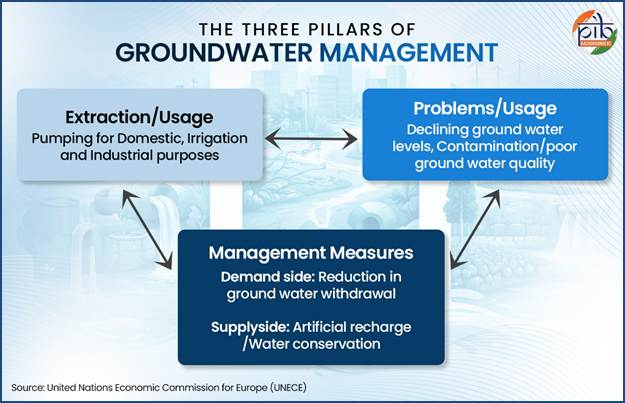
What are the Key Factors Driving the Groundwater Crisis in India?
- Distorted Economic and Policy Incentives: The Minimum Support Price (MSP) system supports water-intensive crops like sugarcane and paddy, while free power for farmers encourages uncontrolled groundwater pumping. Depleting aquifers for farming becomes a policy-driven incentive as a result.
- Demographic and Urban Pressures: Natural recharge zones become impermeable surfaces due to rapid urbanization and population expansion (from 1.29 to 1.45 billion between 2016 and 2023). While concentrated urban and industrial pumping produces severe cones of depression that cause ground subsidence in cities like Chennai and Delhi, this “concrete sealing” significantly lowers rainfall infiltration.
- Climate Change and Hydrological Disruption: The Southwest Monsoon, which supplies around 60% of India’s recharge, is changing due to climate change as a result of decreased aquifer replenishment and increased rainfall unpredictability. Climate adaptation drives groundwater depletion in a vicious cycle where rising temperatures simultaneously increase evaporation and agricultural water demand.
- Pervasive Contamination: Aquifers are contaminated with nitrates, heavy metals (such as chromium, uranium, and lead), and fluoride by fertilizer runoff and industrial effluents, including those from Kanpur’s tanneries. As a result, water is dangerous in many places. Overpumping and increasing sea levels in coastal Gujarat lead to saltwater intrusion, which contaminates freshwater aquifers in 28 out of 33 districts.
- Archaic Legal Framework: The Indian Easements Act of 1882, which views groundwater as a landowner’s private property right rather than a resource shared by all, is at the heart of the governance failure. This makes collaborative management ineffective.
What are the Government Initiatives for the Groundwater Crisis in India?
- Regulatory Framework
- The 2017 Model Groundwater Bill gives states a framework for controlling extraction. Bihar, Punjab, Haryana, and Himachal Pradesh are among the 21 States/UTs that have embraced it. The National Interdepartmental Steering Committee (NISC) facilitates coordination.
- Nationwide Conservation Campaigns
- Jal Shakti Abhiyan: Water conservation, geotagging water bodies, establishing Jal Shakti Kendras, and revitalizing abandoned borewells are its main objectives.
- Jal Sanchay Jan Bhagidari: As of January 2026, it has finished 39,60,333 artificial recharge projects employing scalable models for local groundwater recharge.
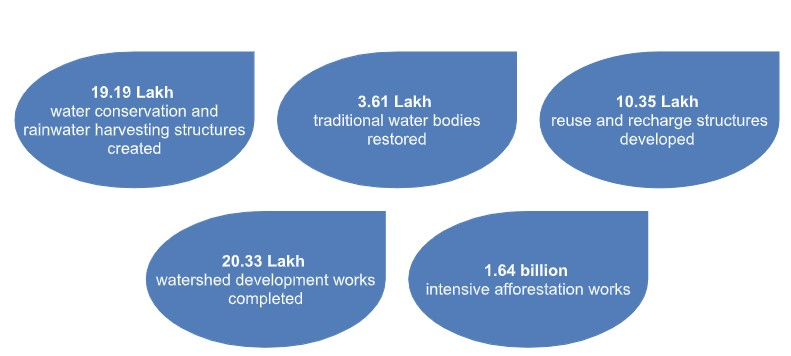
- Scientific Assessment & Planning
- National Aquifer Mapping and Management Programme 2.0: It currently provides Panchayat-level data and intends to characterise aquifers, evaluate their availability and quality, and create aquifer maps for management plans.
- Master Plan for Artificial Recharge to Groundwater-2020: It plans to use terrain-specific methods to channel 185 BCM of extra recharge across 1.42 crore structures.
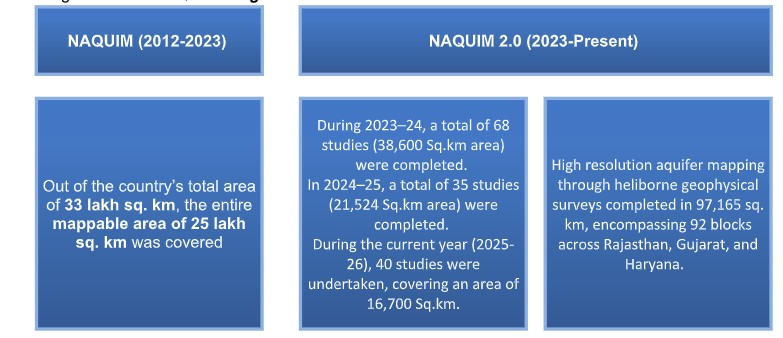
- Community-Led & Targeted Schemes
- Atal Bhujal Yojana (Atal Jal): It doubles farmers’ income and encourages community-led groundwater management in seven water-stressed areas by tying incentives to results to support Jal Jeevan Mission.
- Mission Amrit Sarovar: It aims to improve groundwater recharge and water conservation across all districts by building ponds with a minimum area of 1 acre and a capacity of 10,000 cubic meters.
- Monitoring Infrastructure: The Central Ground Water Board (CGWB) of India has a network of 43,228 groundwater monitoring stations for national surveillance.
What are the Main Tactics used to manage the Groundwater Crisis in India?
- Water-Smart Agricultural Practices
- Groundwater extraction from agriculture may be significantly decreased by encouraging drip irrigation, micro-irrigation, zero tillage, and precision farming.
- Converging PMKSY with the Atal Bhujal Yojana can speed up adoption in regions under stress.
- Institutional Re-engineering
- To effectively manage groundwater, political borders must give way to hydrogeological ones, with the state acting as the custodian under the public trust theory.
- Decentralised Aquifer Management Committees (AMCs) ought to have the legal ability to establish and enforce local extraction limitations using NAQUIM 2.0 data.
- Digital Water Command System
- Create a nationwide network of IoT sensors connected to a central AI platform such as “Bhu-Neer” to monitor groundwater levels, quality, and extraction in real time.
- This would change governance from static to proactive by enabling predictive analytics on aquifer stress and illicit extraction.
- Financial Restructuring to Incentivise Conservation
- Use smart metering for agriculture and a Direct Benefit Transfer (DBT) model for electricity subsidies to separate power subsidies from groundwater exploitation.
- Put in place a groundwater security system, and cease industrial users from financing an Aquifer Recharge Fund that offers rewards for water conservation initiatives spearheaded by local communities.
- Scaling Nature-Based and Advanced Recharge Solutions
- Use Managed Aquifer Recharge (MAR) that is particular to a certain topography, such as charcoal filtration for agricultural runoff or MAR combined with solar desalination in coastal locations.
- To establish a multifaceted recharge environment, metropolitan areas should enforce Rainwater Harvesting (RWH) rules and mandate the recycling of treated wastewater.
- Fostering Climate Resilience
- Invest in hydrogeology literacy and offer a simple Water Budgeting Tool to empower people.
- To foster local stewardship, incorporate climate-resilient crops (such as millets and pulses) into procurement rules and connect VB-G RAM G projects with aquifer recharge.
Conclusion
The Groundwater Crisis in India is a pressing issue that requires urgent attention from policymakers, communities, and individuals. It is not just an environmental problem but a socio-economic challenge that affects millions of people. By adopting sustainable practices, improving water management, and promoting awareness, India can overcome this crisis and secure its water future. The responsibility lies with everyone to conserve water and protect this vital resource.
Frequently Asked Questions (FAQs)
How is groundwater extraction going in India right now?
With a countrywide extraction rate of 60.47% and an annual groundwater extraction of 245.64 BCM, India’s total extraction is still within yearly replenishment capability.
What is groundwater management essential to achieving the Sustainable Development Goals?
By guaranteeing access to clean water, sustainable urbanization, and responsible resource use, groundwater management contributes to SDGs 6, 11, and 12.
How does groundwater sustainability benefit from NAQUIM 2.0?
NAQUIM 2.0 targets water-stressed, coastal, urban, and industrial areas for efficient management and offers high-granularity aquifer data to facilitate Panchayat-level planning.
Sources:
- https://timesofindia.indiatimes.com/india/indias-groundwater-crisis-which-states-are-heading-towards-day-zero-first/articleshow/126059048.cms
- https://www.thehindu.com/children/groundwater-the-invisible-gift/article69353106.ece
- https://blogs.worldbank.org/en/endpovertyinsouthasia/india-seeks-arrest-its-alarming-decline-groundwater
- https://www.deccanherald.com/opinion/editorial/groundwater-crisis-step-up-action-3431847
- https://www.pib.gov.in/PressReleasePage.aspx?PRID=2090573®=3&lang=2
- https://edition.cnn.com/2021/02/24/asia/india-groundwater-study-intl-hnk-scn
- https://en.wikipedia.org/wiki/Water_scarcity_in_India
Leave a Reply