US and Israel Attack on Iran, 2026
Introduction
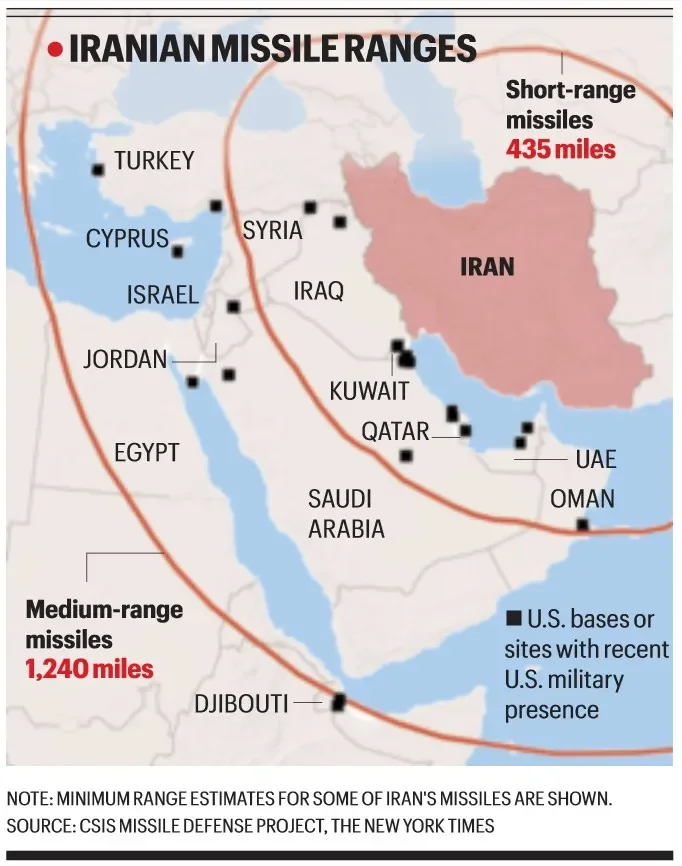
In their coordinated attacks on Iran, the US and Israel allegedly killed Shia cleric Ayatollah Ali Khamenei, Iran’s Supreme Leader, and targeted important strategic installations while demanding regime change. The combined operation, known as Operation Lion’s Roar by Israel and Operation Epic Fury by the US, signaled a significant increase in hostilities in the region. In response, Iran launched missile assaults on Israel and neighboring Gulf states as part of Operation True Promise 4. A larger West Asian confrontation with major global ramifications is feared as a result of the escalation, which occurs despite recent progress in US-Iran nuclear talks.
Why Did the US and Israel Attack on Iran?
- Citing Iran’s ongoing nuclear aspirations and dissatisfied with the 2025 attacks’ minimal impact, the US saw Iran’s sizable ballistic missile and kamikaze drone stockpile as an unacceptable threat to US forces in the Gulf and regional allies.
- The February 2026 strikes targeted decapitation, in contrast to previous operations that prioritized deterrence.
- Supreme Leader Ayatollah Ali Khamenei was supposedly killed in the strikes, and Washington calculated that his removal may cause disintegration within the highly centralized Islamic Revolutionary Guard Corps (IRGC).
- A complex web of factors, including nuclear worries, aspirations for regime change, domestic political pressure, deterrent calculations, and the intensification of strategic commitments, propelled the US military intervention.
What is the Historical Background?
- 1979 Rupture
- Israel and Iran were strategic partners before 1979. Following the Iranian Revolution, the new Islamic government broke off relations with Israel and embraced a fiercely anti-Western philosophy.
- As part of its ideology, the new dictatorship used anti-colonial and anti-imperialist rhetoric to paint the US and Israel as the “Great Satan” and the “Little Satan,” respectively, as drivers of regional exploitation.
- Iran’s Nuclear Revelation
- When the world learned about Iran’s covert nuclear program in the early 2000s, tensions skyrocketed.
- Regional Expansion
- There was a political vacuum following the US-led removal of Saddam Hussein of Iraq, one of Tehran’s main regional rivals.
- To challenge US and Israeli domination, Iran took advantage of this and established its “Axis of Resistance,” a network of allied proxy organizations throughout the Middle East that includes the Houthis in Yemen, Hamas in Gaza, and Hezbollah in Lebanon.
- JCPOA Agreement
- The European Union, Iran, and the P5+1 (China, France, Germany, Russia, the United States, and the United Kingdom) signed the Joint Comprehensive Plan of Action (JCPOA) in 2015 to stop Iran’s development of a clandestine nuclear program.
- In return for stringent restrictions on uranium enrichment, it offered reprieve from sanctions.
- US Withdrawal (2018)
- Claiming that Iran’s ballistic missile program and its financing of the “Axis of Resistance” were overlooked, making the JCPOA dangerously defective.
- In 2018, the US pulled out of the JCPOA on its own. As a result, Iran rapidly increased its uranium enrichment to the point where it was nearly ready for use in weapons.
- Collapse of the “Axis of Resistance” (2023–24)
- Israel’s multi-front war following the October 2023 Hamas attack killed Hezbollah’s leadership, crippled Hamas, and helped bring down Syria’s Bashar al-Assad, depriving Iran of vital regional buffers.
- Operation Midnight Hammer (June 2025)
- Israel attacked Iran’s nuclear facilities at Isfahan and Natanz in advance. Later, the US participated, striking the heavily defended Fordow complex with bunker-buster bombs and B-2 aircraft.
- The US stated that the attacks seriously damaged Iran’s nuclear infrastructure and facilities with the intention of delaying its nuclear program by interfering with vital capabilities and important enrichment locations.
What Consequences Does the US and Israel-Iran War Have?
Global
- Threat to Global Energy Security
- The escalation has a significant effect on the Strait of Hormuz, a crucial maritime chokepoint.
- Every day, the strait transports 20–30% of the world’s exports of LNG and 20 million barrels of crude oil, or about 20% of the world’s total consumption.
- Any Iranian mining or blockage of this strait might cause the world’s energy markets to become paralyzed, which would cause the price of crude oil to skyrocket.
- Geopolitical Polarization
- The war runs the danger of attracting additional superpowers.
- While the US solidifies its Western and Arab friends, further dividing the world order, Russia and China may strengthen their strategic ties with Iran.
- Disruption of Global Supply Chains
- Global freight and insurance prices are rising as a result of the militarization of West Asian air and oceans, which obstructs vital commerce routes that link Asia and Europe.
- Commodity and Market Volatility
- The crisis has raised the “war premium” in international markets by causing big dealers to halt energy exports.
- Stock exchanges in Dubai and Abu Dhabi have stopped trading, and gold prices have risen as investors seek protection.
India
- Energy Security and Economy
- India imports more than 85–88% of its crude oil needs, making it the third-largest user in the world.
- The Strait of Hormuz receives between 2.5 and 2.7 million barrels of oil per day from Saudi Arabia, Iraq, the United Arab Emirates, and Kuwait.
- Almost 60% of LNG imports and 80–85% of LPG imports pass via Hormuz.
- However, strategic petroleum reserves and a variety of Russian imports have “covered for now” India’s urgent oil demands. Unlike crude oil, India does not have significant strategic stocks of LPG or LNG.
- Due to the restricted spot availability of LNG and LPG, supply interruptions are more difficult to handle.
- A protracted Hormuz interruption would cause oil prices to rise over $100 per barrel, significantly increasing India’s import costs.
- Reserves and a variety of suppliers allow for the management of short-term demands, but a protracted dispute might increase the current account deficit, drive up inflation, and put further burden on the economy.
- Safety of the Indian Diaspora
- Nearly 9 million Indian expatriates reside in West Asia, and they make a substantial contribution to inbound remittances.
- The main issue is the diaspora’s safety. If things become worse, the government could have to start massive evacuation efforts (like Operation Rahat or Operation Ajay).
- Diplomatic Tightrope
- India has vital historical, energy, and connectivity links with Iran in addition to its close strategic partnerships with the US and Israel.
- It is bad for India’s interests to adopt a partisan position. Promoting peace and denouncing civilian casualties without upsetting any strategic allies is the difficult part.
- Disruption of Connectivity Corridors
- The Gulf’s militarization seriously undermines India’s plans for strategic connectivity.
- The collapse of the Arabian Peninsula port infrastructure threatens the existence of the planned India-Middle East-Europe Economic Corridor (IMEC) and jeopardizes operations at the Chabahar Port (Iran).
How may India prevent the effects of the US and Israel-Iran conflict?
- Activation of Strategic Buffers
- While actively looking at alternative LPG/LNG purchases from non-Gulf countries like the US or Australia, the government must be ready to use the Strategic Petroleum Reserves (SPR) to protect the domestic market from any price shocks.
- Evacuation Contingency Readiness
- To provide safe passageways for the evacuation of the Indian diaspora, prepare evacuation Standard Operating Procedures (SOPs) in collaboration with the Indian Navy and the Ministry of Civil Aviation.
- Maintain Air India and the Indian Air Force on standby for massive airlifts akin to Operation Ganga (Ukraine).
- Increase the Indian Navy’s presence in the Gulf of Oman and the Arabian Sea by growing operations like Operation Sankalp, which aims to safeguard Indian commercial ships close to areas of conflict.
- Strategic Autonomy in Diplomacy
- India has to walk a tightrope in terms of diplomacy. In order to obtain exclusions for Indian boats and promote the demilitarization of commercial maritime channels, it must heavily backchannel with Tehran and Muscat (Oman), but it cannot afford to offend Washington or Tel Aviv.
- Subsidies and Tax Interventions
- The federal and state governments may need to absorb the shock by lowering excise taxes and Value Added Tax (VAT) on gasoline and diesel in order to avoid the global “war premium” from going straight to the average citizen.
- Advocating for De-escalation at the UN
- India has to make it clear that “this is not an era of war.”
- While denouncing civilian fatalities, India should refrain from adopting a partisan, zero-sum approach that would offend Iran or the US-Israel coalition and instead concentrate solely on resuming communication and reestablishing international supply channels.
Conclusion
The West Asian escalation in 2026 highlights India’s susceptibility to threats to diaspora safety and energy security. India can protect its interests while reiterating that this is not a time of war by upholding its strategic autonomy and serving as a stabilizing, nonpartisan voice for peace, embodying the role of a Vishwa Bandhu (global friend).
Frequently Asked Questions (FAQs)
What are Lion’s Roar and Operation Epic Fury?
Tensions in West Asia significantly increased in 2026 as a result of US and Israeli military operations that targeted Iran’s vital infrastructure and leadership.
Why is the Strait of Hormuz essential to the security of the world’s energy supply?
It transports 20–30% of the world’s LNG exports and 20% of the world’s oil; any disruption might cause price spikes.
Describe the JCPOA and explain the US’s withdrawal.
The US withdrew in 2018, alleging missile projects and proxy assistance, from the 2015 nuclear agreement that restricted Iran’s enrichment in exchange for the lifting of sanctions.
What impact does the war have on India’s energy security?
India is susceptible to supply interruptions and price surges since it imports more than 85% of its crude oil, with a significant portion going via Hormuz.
Why does India’s strategic autonomy matter in this conflict?
It protects India’s energy, diaspora, and commerce interests while enabling it to maintain balanced ties with rival states.
Sources:
- https://en.wikipedia.org/wiki/Prelude_to_the_2026_Iran_conflict
- https://edition.cnn.com/world/live-news/us-israel-iran-attack-03-01-26-intl
- https://commonslibrary.parliament.uk/research-briefings/cbp-10521/
- https://en.wikipedia.org/wiki/2026_Iran_conflict
- https://www.nytimes.com/live/2026/03/02/world/iran-us-israel-attack-trump
- https://www.thehindu.com/news/international/israel-attack-on-iran-february-28-2026/article70687211.ece
- https://www.bbc.com/news/articles/cx2dyz6p3weo
Leave a Reply