

Ethanol Blending In India, 2026
Introduction
Ethanol Blending in India has emerged as a powerful strategy to reduce the country’s dependence on imported crude oil and promote cleaner energy alternatives. With nearly 85% of its crude oil needs being met through imports, India has long been vulnerable to global price fluctuations and geopolitical uncertainties, particularly in West Asia. From barely 1.5% in 2013 to over 18% in 2024, Ethanol Blending in India has grown quickly, indicating a significant change in policy. This adjustment is expected to reduce CO2 emissions by around 10 million tons and save over ₹30,000 crore in foreign exchange yearly.
What is Ethanol Blending in India?
- About
- The process of combining ethyl alcohol (ethanol) with gasoline (petrol) to make mixed motor fuel is known as ethanol blending. The resultant mixture powers either specialist flex-fuel cars or conventional internal combustion engines.
- In India, blending is often reported as “E10” or “E20,” where the proportion of ethanol in the mixture is indicated by the number.
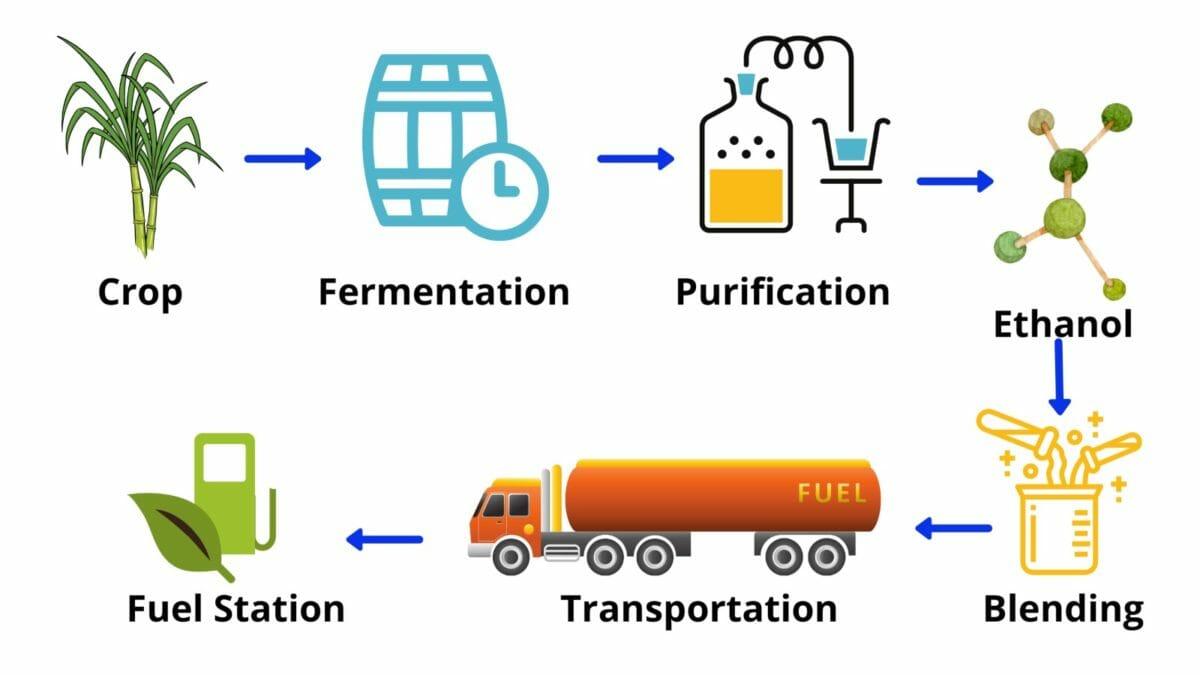
- Process of Ethanol Formation
- 1G (First Generation): Produced from food sources such as broken food grains (rice or maize), sugarcane juice, molasses, and corn.
- 2G (Second Generation): Produced from agricultural wastes and trash, including maize cobs, rice straw, and wheat straw (lignocellulosic biomass).
- 3G (Third Generation): Derived from algae cultivated in different types of water.
- 4G (Fourth Generation): It is a cutting-edge biofuel made by employing sophisticated microbial fermentation to turn renewable hydrogen and industrial collected pollutants into fuel. 4G ethanol offers a sustainable, non-food-based feedstock alternative by avoiding dependency on food crops, in contrast to earlier generations.
- Policy Framework for Ethanol Blending in India
- The National Policy on Biofuels, which offers the general framework for advancing biofuels and lowering reliance on fossil fuels, mostly governs ethanol blending in India.
- The goal of 20% ethanol blending (E20) in gasoline was moved from the previous 2030 deadline to the Ethanol Supply Year (ESY) 2025–2026 by the National Policy on Biofuels 2018, as revised in 2022.
- Under the government’s Ethanol Blended Petrol (EBP) Program, OMCs sell gasoline that has up to 20% ethanol added.
- Additionally, the government reduced the GST rate on ethanol for Ethanol Blended Petrol (EBP) to 5%.
How Important Is Ethanol Blending in India?
- Strengthening Strategic Energy Autonomy
- Blending ethanol serves as a crucial buffer against the unstable geopolitics of West Asia, preventing the Indian economy from being paralysed by disruptions in global supplies.
- India lessens its vital reliance on imported crude oil during times of global strife by localising a portion of the fuel supply.
- When tensions in West Asia increased in early 2026, India’s 20% blending (E20) acted as a domestic buffer, keeping Delhi’s fuel costs below 2021 levels.
- In ESY 2025, nearly 20% blending was achieved, saving the country an estimated $19.3 billion in foreign exchange.
- To lessen reliance on oil imports, the Indian government has also suggested that ethanol blending in gasoline might be raised from the current 20% to 21%.
- Radical Transformation of Rural Economy
- The ethanol blending program has transformed “food-surplus” into a strategic “fuel-resource,” giving farmers access to a reliable and lucrative market outside of traditional food procurement.
- By connecting agriculture with energy generation, ethanol blending empowers farmers as both Annadata and Urjadata.
- The Department of Food & Public Distribution (DFPD) claims that the sale of ethanol has improved sugar mills’ financial flows, enabling them to pay cane producers on time.
- The sale of ethanol brought in more than Rs 1 lakh crores for sugar mills between 2014–15 and 2023–24, improving their financial situation.
- Additionally, between FY22 and FY25, administered prices for ethanol made from maize increased at a CAGR of 11.7%, much exceeding the growth of traditional grain prices.
- Decarbonization and Climate Leadership
- India may satisfy its NDCs under the Paris Agreement by using ethanol, a cleaner-burning oxygenated fuel that dramatically reduces the transportation sector’s carbon impact.
- It offers a quick approach to cut exhaust emissions without having to wait for the complete electrification of the fleet of vehicles.
- According to NITI Aayog research, ethanol derived from sugarcane decreases greenhouse gas emissions by 65%, but ethanol derived from maize reduces them by 50%.
- Pioneering the Circular Bio-Economy
- Utilising agricultural “waste” (stubble/husk), the deployment of Second-Generation (2G) ethanol facilities addresses the dual issues of energy production and environmental degradation.
- As a result, crop leftovers that were formerly burnt in fields are transformed into a lucrative industrial fuel.
- In Bargarh, Odisha, BPCL put into operation a commercial-scale 2G refinery in March 2026 that produces 100 kiloliters of ethanol per day from rice straw.
- Similar infrastructure can focus on reducing stubble burning, which is a significant contributor to Northern India’s winter haze.
- Stimulating Automotive Technological Innovation
- The Indian car industry has had to quickly modernise its technology due to the switch to E20 and Flex-Fuel Vehicles (FFVs), which has made Indian-produced automobiles competitive on the world stage.
- In order to manage the increased corrosiveness of ethanol, manufacturers are now re-engineering engines, creating a new ecosystem of specialist auto-components.
- Giants like Maruti Suzuki and Tata Motors have launched E20-compliant cars across their entire portfolios as a result of E20 being the standard retail gasoline in India.
- To further push these technical limits, E21 and E27 mixes are presently undergoing testing.
- Fiscal Stability and Macroeconomic Health
- Ethanol blending helps control the Current Account Deficit (CAD) and stabilises the Indian Rupee by drastically lowering the oil import cost.
- The government may reallocate billions of dollars from energy imports to domestic infrastructure and social programs thanks to this budgetary space.
- With 20% ethanol blending, India saved USD 19.3 billion in foreign exchange. With India expected to account for 10% of the world’s energy needs by 2050, these savings are crucial.
- Promotion of Global Leadership
- India has established itself as a global leader in biofuel policy through the Global Biofuel Alliance (GBA), exporting its “India Model” to other poor countries.
- In addition to strengthening India’s “Soft Power,” this South-South collaboration opens up export markets for Indian ethanol technology and technical services.
- India demonstrated its quick rise from 1.5% blending in 2013 to 20% in 2025 during the 2026 India Energy Week.
- Under GBA frameworks, countries like Brazil and other African countries are now using this “leapfrog” accomplishment as a model for the implementation of biofuel.
What are the Issues Associated With Ethanol Blending In India?
- Food Security vs. Fuel Feedstock Competition
- Nutritional security is at risk due to the relentless push for ethanol feedstock, especially maize, which is unintentionally warping agricultural goals.
- Farmers are abandoning vital food crops in favor of profitable, ethanol-bound grains due to favorable government pricing practices.
- While maize yields increased 48% during FY16, other crops, including oilseeds and pulses, suffered a decline in acreage, according to the Economic Survey 2026.
- This change exposes the local market to considerable fluctuations in food prices and runs the danger of increasing India’s reliance on edible oil imports.
- The 2G Technology Bottleneck
- Severe technological constraints are preventing second-generation (2G) ethanol plants—which are intended to use agricultural residues—from meeting output targets.
- Agricultural waste’s wildly inconsistent quality seriously harms downstream treatment equipment, resulting in significant operational inefficiencies.
- Since its opening, IOCL’s historic 2G ethanol facility in Panipat has continuously run below its 100 KLPD design capacity.
- Automotive Taxation and Flex-Fuel Viability
- Although the automotive industry has created Flex-Fuel Vehicle (FFV) prototypes that can use high ethanol mixes, market adoption is being stifled by strict tax laws.
- When compared to other green technologies, the ordinary consumer finds these sustainable options to be financially undesirable due to the lack of a fair playing field.
- Flex-fuel cars will be subject to Goods and Services Tax (GST) rates ranging from 18% to 40% as of April 2026, whereas electric vehicles would only be subject to 5%.
- To increase customer demand, automakers like Maruti Suzuki and Bajaj are postponing mass production until the government rationalizes these tariffs.
- Severe Groundwater Depletion Risks
- India’s delicate groundwater supplies are still under unsustainable stress due to the country’s heavy reliance on first-generation (1G) feedstocks, mostly sugarcane.
- The fundamental ecological and environmental tenet of the biofuel transition is totally undermined by increasing intensive planting in historically dry areas.
- Major producing states like Maharashtra and Uttar Pradesh suffer from acute water constraint because to the famously water-intensive nature of sugarcane farming.
- The expected transition from water-guzzling paddy to less demanding crops has not materialized successfully despite legislative efforts, exacerbating regional aquifer degradation.
- Engine Degradation and Consumer Hesitancy
- Ethanol’s intrinsic chemical characteristics, particularly its high hygroscopicity, present serious mechanical risks to fleets of older cars that are not E20-optimized.
- Long-term use of mismatched engines causes internal moisture buildup, which speeds up corrosion, degrades seals, and causes crucial component failure.
- Customers are increasingly reporting expensive auto problems that are directly related to extended use of E20 fuel, such as blocked fuel injectors and damaged rubber seals.
What Steps are Required to Strengthen Ethanol Blending In India?
- Deeptech-Driven Supply Chain Synchronization
- Organize an integrated feedstock logistics network using deep-tech predictive modeling and artificial intelligence to address spatial mismatches between refining locations with refining shortages and agricultural centers with excess capacity.
- To proactively avoid structural market gluts, this digital infrastructure must monitor agricultural yields, biomass availability, and distillery capacity in real time.
- Oil marketing companies may easily integrate dispersed residue collection with ongoing refinery intake requirements by digitizing procurement algorithms.
- Throughout the entire biofuel lifecycle, this systematic synchronization minimizes transportation-induced carbon emissions while guaranteeing continuous processing.
- Transitioning to Water-Resilient Natural Farming
- Redirect agricultural incentives toward climate-resilient coarse grains grown using sustainable natural farming paradigms to separate ethanol production from water-guzzling crops.
- In order to award or renew commercial distillery licenses, village-level water governance audits and assessments of the health of the aquifer must be required.
- This eco-centric change ensures that biofuel feedstocks be vigorously farmed without affecting long-term soil vitality while protecting local ecosystems and endangered wetlands.
- It radically realigns the energy transition with the need to safeguard agricultural biodiversity and regional hydro-security.
- Fiscal Rationalization and Green Taxation Parity
- Implement a targeted fiscal consolidation plan that aligns the Flex-Fuel car Goods and Services Tax structure with the present battery electric car preferential rates.
- Giving automakers production-linked green credits and targeted subsidies will speed up technology adoption and significantly reduce upfront customer acquisition expenses.
- The financial obstacles preventing high-blend compatible cars from entering the mass market are actively removed by establishing this general tax parity.
- As a result, the end-user is gradually relieved of the financial burden of implementing sustainable transit, which increases organic market demand.
- Mandating Carbon Capture Integration
- By integrating Carbon Capture, Utilization, and Storage infrastructure directly into distillation plants, the regulatory framework may shift from volume-based blending limits to strict carbon-intensity standards.
- Conventional distilleries are successfully converted into carbon-negative industrial assets by capturing the concentrated biogenic carbon dioxide continually released throughout the microbial fermentation process.
- These crucial technology retrofits may be easily financed at scale by taking use of national financial provisions for climate infrastructure.
- This integration ensures that instead of only using intense industrial exhaust to replace tailpipe emissions, the biofuel industry actively sequesters greenhouse gases.
- Decentralized 2G Biorefinery Ecosystems
- To avoid the enormous logistical challenges of moving large agricultural leftovers, decentralize the biofuel industrial footprint by building micro-level, second-generation biorefineries right at the district level.
- By giving farmers very accessible and profitable ways to dispose of agricultural waste, this targeted deployment instantly tackles the structural problem of crop stubble burning.
- Encouraging such a circular bio-economy at the local level strengthens local supply chains and empowers rural organizations.
- In the end, this protects the country’s energy infrastructure from the macroeconomic risks linked to centralized, single-point supply chain breakdowns.
Conclusion
Ethanol blending in India by 2026 represents a decisive shift toward energy security, rural prosperity, and cleaner growth. While strong policy support and rapid progress are evident, challenges around food security, water stress, technology, and consumer adoption remain. A balanced, innovation-driven approach will be essential to ensure the sustainability, economic resilience, and long-term success of India’s biofuel transition in future years.
Frequently Asked Questions (FAQs)
What is India’s current ethanol blending target?
By 2025–2026, India wants to incorporate 20% ethanol into gasoline (E20).
What distinguishes 2G ethanol from 1G?
While 2G uses non-food agricultural wastes like rice straw and maize cobs, 1G uses food crops like corn and sugarcane.
What is a Flex-Fuel Vehicle (FFV)?
It is a car with an internal combustion engine that can operate on any ratio of ethanol to gasoline.
What makes ethanol “oxygenated”?
Its chemical structure includes oxygen, which aids in the fuel’s more thorough burning and lowers dangerous exhaust emissions.
Sources:
- https://timesofindia.indiatimes.com/india/government-hints-ethanol-blending-in-petrol-can-be-increased-by-a-percent/articleshow/130242938.cms
- https://www.pib.gov.in/PressReleasePage.aspx?PRID=2155558®=3&lang=2
- https://www.niti.gov.in/sites/default/files/2021-06/EthanolBlendingInIndia_compressed.pdf
- https://www.thehindu.com/business/Economy/what-has-been-the-impact-of-ethanol-blending/article69943693.ece
- https://en.wikipedia.org/wiki/Ethanol_fuel
- https://indianexpress.com/article/explained/explained-economics/iran-war-why-india-must-step-on-the-gas-with-ethanol-10596597/
- https://www.indiatoday.in/india/story/ethanol-blending-fuel-imports-pm-modi-e20-push-hormuz-iran-west-asia-middle-east-crisis-2888577-2026-03-29
Leave a Reply