

Tribal Violence in Manipur and UAPA Power Growth
Introduction
A notification enforcing Section 43A of the Unlawful Activities (Prevention) Act (UAPA), 1967, was released by the Manipur Home Department. This instruction permits statewide arrests, searches, and seizures by lower-ranking law enforcement personnel.
What are the Provisions of the UAPA, 1967 Notification in Manipur?
- Empowerment of Lower-Ranked Officers
- Citing a heavy First Information Report (FIR) workload and a lack of senior officers during the current unrest, the notice permits officers in civil and armed police who are not below the level of Head Constable or Havildar to wield broad anti-terror powers.
- Due to the strict nature of the legislation, these powers are often restricted to senior officials such as the Assistant Commissioner of Police (ACP) or Deputy Superintendent of Police (DSP).
- Appointment of “Designated Authority”
- This section designates the state’s Secretary (Home) as the official “designated authority” to supervise measures against offenses related to illegal and anti-national activities.
- The “Reason to Believe” Standard
- If an authorized authority has “reason to believe” that a UAPA-related violation has been or may be committed, they may make an arrest or search.
- This also holds in situations where there may be evidence or property connected to illegal activity.
- Unrestricted Search and Seizure
- The instruction permits the chosen police to search cars, buildings, and other locations at any time, even at night.
- Additionally, it authorizes the seizure of any assets or records deemed pertinent to the inquiry.
- Indefinite Timeline
- To speed up operational reaction times on the ground, the notification went into effect immediately and will be in place until further notice.
What Are the Manipur Unlawful Activities (Prevention) Act (UAPA) Concerns?
- High Risk of Misuse
- Strict bail requirements and lengthy pre-charge detention periods (up to 180 days) are hallmarks of the UAPA, an anti-terror statute.
- Rights organizations contend that arbitrary arrests may result from lower-ranking officers’ lack of the specific training, legal knowledge, or objectivity needed to handle such delicate situations.
- If the court finds that the police claims are prima facie genuine, it is practically hard for an accused person to get bail under UAPA.
- Even a false arrest by a lower-ranking officer might result in an innocent individual spending years behind bars without a trial, since the burden of proof is significantly stacked against the accused.
- The “cause to believe” criterion is susceptible to abuse in the absence of senior control, allowing for personal grudges, blackmail, or harassment under the pretense of national security.
- Deepening the Trust Deficit
- Giving local inspectors broad anti-terror powers might exacerbate the alienation of marginalized populations in a very divisive atmosphere where state police agencies have been accused of ethnic prejudice.
- Violation of Legislative Intent
- In the past, the Supreme Court has stressed that the UAPA’s need for higher-ranking investigating officials is a substantive protection against governmental overreach rather than just a formality.
- Criminalizing Peaceful Dissent
- A “climate of psychological anxiety” is being fostered by rights organizations such as the fear of the law.
- There are serious worries that unarmed citizens, like the women’s organizations in the Imphal Valley protesting the Tronglaobi killings, may be disproportionately targeted under the UAPA, essentially characterizing requests for justice and civil unrest as “anti-national” terrorist acts.
Also read: Manipur Violence, 2023
What is the Manipur Violence Crisis?
Core Triggers of the Conflict
- The Scheduled Tribe (ST) Status Demand
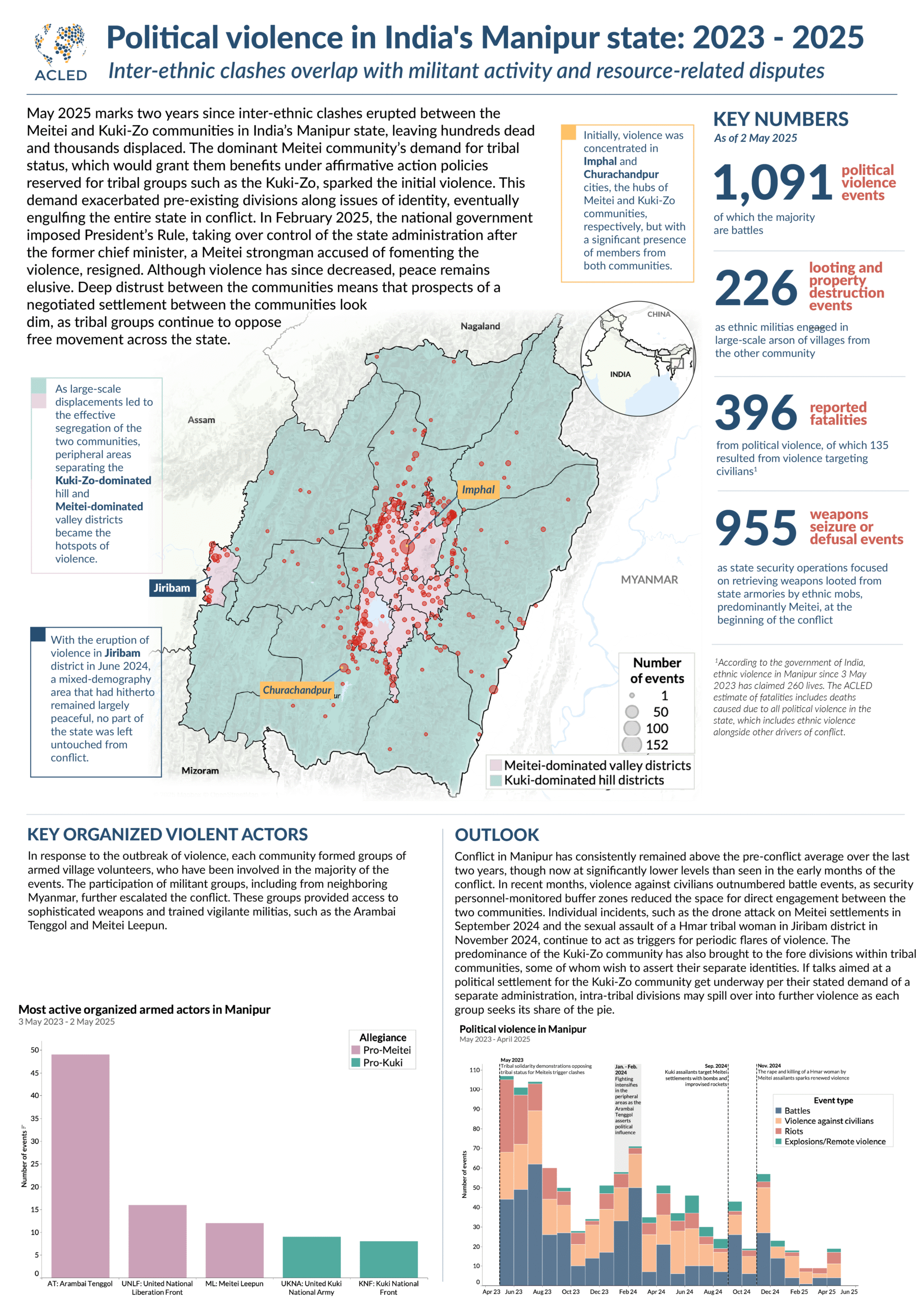
- A ruling from the Manipur High Court in April 2023 ordering the state administration to suggest ST classification for the Meitei community served as the immediate stimulus.
- Before Manipur’s 1949 union with the Union of India, the Meiteis were acknowledged as a tribe.
- The Kuki-Zo tribes were adamantly against this because they believed that giving the politically powerful Meiteis ST status would enable them to dominate government positions and educational quotas, as well as purchase property in the hills.
- Forest Evictions and the “War on Drugs”
- The state administration launched a strong campaign against illegal poppy farming and carried out eviction efforts in protected forest areas before the conflicts.
- Kuki organizations said that these efforts demonized their whole community as “narco-terrorists” and specifically targeted their ancient villages.
- This is delicate because Manipur is located on the border of the “Golden Triangle,” a region in Southeast Asia that includes civil war-torn Myanmar and is one of the world’s major hubs for the trafficking of heroin, opium, and synthetic narcotics like methamphetamine.
- Myanmar Influx
- Thousands of Chin refugees entered Manipur over the porous border after the military coup in Myanmar in 2021.
- The Meiteis expressed concern that this unrestrained migration of individuals with close ethnic links to the Kuki-Zo was artificially changing the demographics of the state and intruding on scarce valley resources.
- Tensions and public mistrust have been maintained by the proliferation of weapons, community division through buffer zones, and increased UAPA powers.
Geographic, Demographic, and Political Fault Lines
- Geographic and Demographic Fault Lines
- Imphal Valley:
- The valley is heavily inhabited, making up only 10% of the state’s total land area.
- The non-tribal Meitei group, who comprise around 53% of the state’s total population (according to the 2011 Census), is the main inhabitant.
- Hill Districts
- Ninety percent of the region is made up of the hills that surround the valley.
- The Kuki-Zo and Naga populations are the two main recognized Scheduled Tribes (ST) living in these territories.
- Land Law Disparity
- The tribal hill regions are protected by the constitution under current legislation. There is no land for non-tribal people to buy. Nonetheless, the Imphal Valley is open to the settlement and purchase of land by indigenous communities.
- The Meiteis now have a strong feeling of geographic constraint as a result.
- Imphal Valley:
- Political Asymmetry
- Valley Dominance in the Assembly
- Forty of the sixty Members of Legislative Assembly (MLAs) in the state are from the Imphal Valley.
- The Meitei community now has enormous political and legislative power in the state government as a result.
- Marginalization of the Hills
- Only 20 MLAs represent the vast hill areas in the Assembly.
- Tribal tribes have long claimed that systemic developmental inequities are a result of this extreme political imbalance.
- Valley Dominance in the Assembly
Way Forward
- Assess the ST status criteria (to Meities)
- Meiteis’ request for ST status must be carefully considered in light of the committee’s stated standards. The Lokur Committee (1965) established five indicators: backwardness, shyness of interaction, geographical isolation, separate culture, and primitive features.
- Legal Safeguards
- The state administration has to reevaluate giving lower-ranking personnel UAPA authority. Special investigation teams (SITs) headed by senior, unbiased police from beyond the immediate conflict zones should be established if manpower is a problem.
- Disarmament and Rehabilitation
- Any significant de-escalation must precede the safe rehabilitation of internally displaced people (IDPs) and involve a methodical, open, and impartial effort to retrieve looted weapons.
- Address structural disparities
- Assure equitable resource allocation, development in Hill districts, and a balanced constitutional approach to land/ST concerns.
- Manage borders effectively
- To address demographic issues, strengthen border security between India and Myanmar while implementing a humanitarian, regulated refugee policy.
Conclusion
The state of affairs in Manipur is an example of the complicated interplay between human rights issues and security difficulties. Strong legal instruments like UAPA may be required in conflict areas, but in order to maintain long-term peace and stability, their use must be reasonable, responsible, and consistent with the constitution.
Frequently Asked Questions (FAQs)
What is the main clause in Manipur’s most recent UAPA notification?
Under anti-terror legislation, it permits officials of the Head Constable/Havildar rank to make arrests, searches, and seizures.
What makes the action contentious?
Lack of senior control puts it at danger for abuse, which might result in arbitrary arrests and human rights abuses.
What does UAPA’s “reason to believe” requirement entail?
It permits action based on suspicions of illegal activities, which can be arbitrary and easily abused.
What are the main reasons behind the war in Manipur?
Land rights, the quest for ST status, the ethnic difference (Meitei vs. Kuki-Zo), and the flood of refugees from Myanmar are important causes.
What steps are recommended to end the crisis?
Discussion, disarmament, fair development, legal protections, and improved border control were among the solutions.
Sources:
- https://www.pib.gov.in/PressReleseDetailm.aspx?PRID=2118913®=3&lang=2
- https://blogs.lse.ac.uk/humanrights/2024/03/14/ethnic-cleansing-and-brewing-civil-war-in-the-case-of-indias-manipur/
- https://en.wikipedia.org/wiki/2023%E2%80%932026_Manipur_conflict
- https://www.mha.gov.in/en/divisionofmha/north-east-division
Leave a Reply