

The Transformation of Tourism Sector in India
Introduction
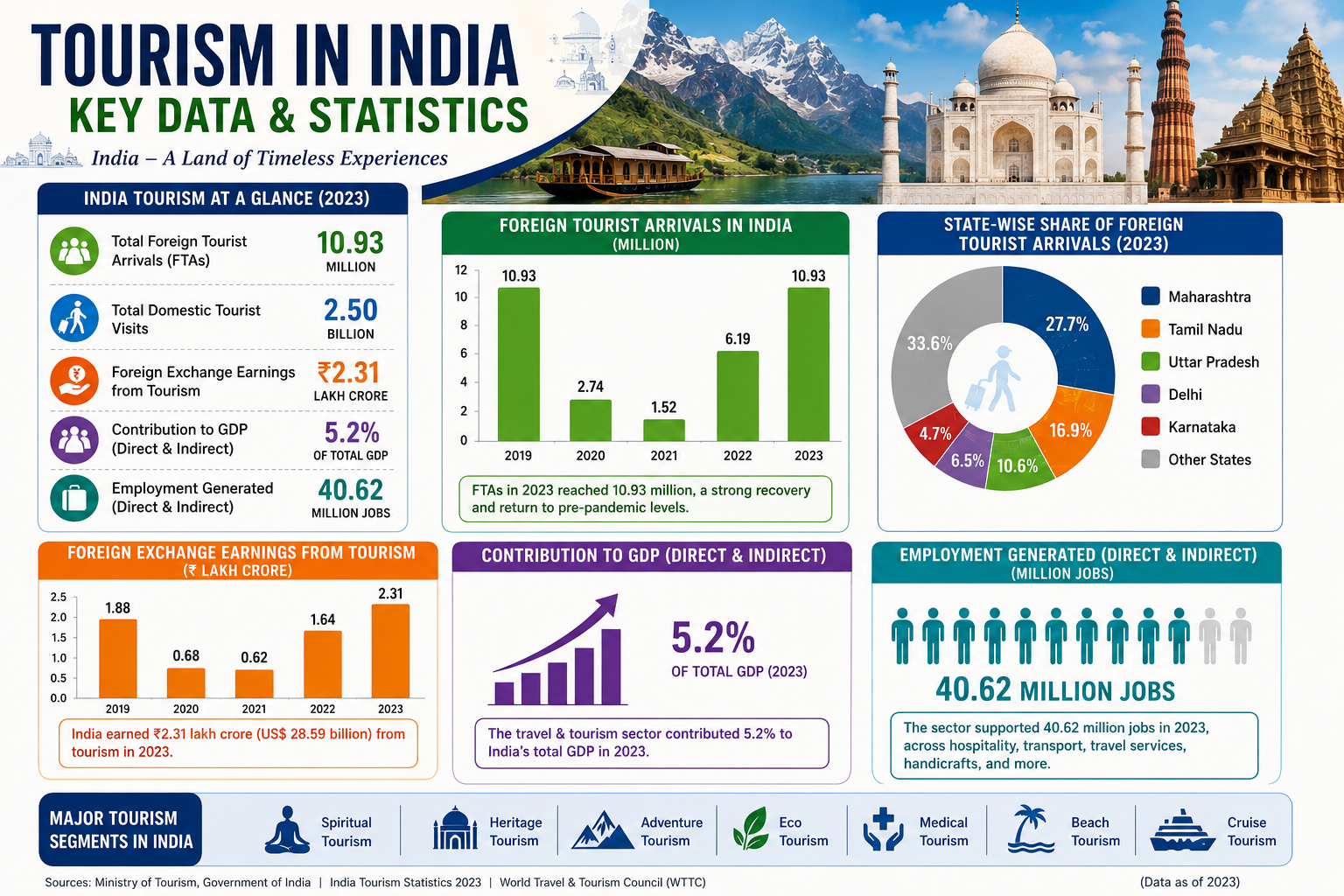
Despite its enormous cultural and geographic potential, the tourism sector in India is at a crucial crossroads, with about 20–22 million international visitors each year. High-value foreign travelers are still discouraged by strict visa regulations, short validity terms, and few multi-entry opportunities, even after the country expanded its e-visa regime to over 160 nations. India has failed to completely adopt the strategy used by rivals like Thailand, which regularly attracts 35–40 million visitors annually by combining simple access with seamless experiences.
What are the Developments Shaping Tourism Sector in India?
- Domestic Resurgence of Tourism
- By providing financial incentives and turning “hidden jewels” into upscale travel destinations, the government has effectively changed the middle-class perspective toward high-value domestic exploration.
- In order to create theme-based tourism circuits, the Ministry of Tourism introduced the Swadesh Darshan Scheme in January 2015.
- Domestic tourists are now the main participants in the tourism resurgence thanks to the strategic marketing of unusual destinations and the “Chalo India” diaspora outreach.
- Additionally, 15 archaeological sites—including Lothal, Dholavira, Rakhigarhi, Sarnath, Hastinapur, and Leh Palace—will be transformed into immersive cultural tourist destinations, according to the Budget 2026.
- The Renaissance of Spiritual Tourism
- India is developing world-class pilgrimage ecosystems that strike a balance between contemporary conveniences and holy preservation by utilizing its deeply ingrained spiritual identity.
- The Ramayana and Buddhist Circuits in the State of Uttar Pradesh have finished the projects approved under the Swadesh Darshan plan.
- In order to promote the integrated development of the nation’s chosen pilgrimage sites, the Ministry of Tourism also introduced the National Mission on Pilgrimage Rejuvenation and Spiritual Heritage Augmentation Drive (PRASHAD) Scheme.
- Over 72.6 million devotees and visitors visited Kashi Vishwanath Dham in 2025 alone, a historic milestone, and religious tourism accounted for 60% of all domestic travel in 2025.
- Fast Communication and “Micro-cation” Infrastructure
- By significantly cutting down on transit times between commercial and recreational hubs, the Indian government’s infrastructure agenda is transforming regional travel.
- The emphasis on “UDAN” air connectivity and high-speed rail (Vande Bharat) is helping “micro-cations”—shorter, more frequent travel that stabilizes demand throughout the year.
- Tourism is becoming more decentralized due to the construction of new high-speed rail tracks, which enable visitors to visit far-off, picturesque locations and historical sites in half the time it used to take by car.
- Mumbai-Pune and Delhi-Varanasi are two of the seven new high-speed rail lines promised in the Union Budget 2026.
- India’s first significant move toward the installation of high-speed rail lines is the Mumbai–Ahmedabad High-Speed Rail (MAHSR) Corridor.
- Growth into a Worldwide Center for Health and Well-Being
- India is deliberately establishing itself as the “world’s pharmacy and clinic” by fusing cutting-edge medical techniques with age-old health practices like Ayurveda.
- This “Heal in India” program draws wealthy foreign patients looking for reasonably priced, top-notch surgical procedures combined with a comprehensive rehabilitation.
- The market for medical travel in the nation is projected to increase from USD 8.7 billion in 2025 to USD 16.2 billion in 2030.
- India is becoming a top choice for complicated procedures because of a clear cost advantage, a sharp rise in approved institutions, and an efficient e-Medical Visa system.
- Leadership in Sustainable Wildlife and Ecotourism
- India is asserting its leading position in conservation-led tourism that places an emphasis on ecological integrity and community involvement by hosting the Global Big Cat Summit in June 2026.
- A trend toward low-impact, high-engagement tourism that preserves biodiversity is reflected in the creation of nature-based circuits.
- A pilot initiative to upskill 10,000 tour guides in sustainable practices across 20 renowned places further solidifies the government’s development of dedicated eco-trails throughout the Himalayas and Western Ghats.
- Additionally mentioned are bird-watching trails along Pulicat Lake in Andhra Pradesh and turtle trails along important nesting locations in the coastal regions of Odisha, Karnataka, and Kerala.
- Growth of the Blue Economy: River and Cruise Tourism
- To build a strong cruise tourism industry, India is actively using its vast internal waterways and 11,000 km of coastline.
- In order to draw in international cruise lines and promote a new age of opulent river travel, the nation is updating its main ports under the Cruise Bharat Mission.
- India demonstrated its potential to international operators like as Royal Caribbean at Seatrade Cruise Global 2026.
- Ecosystems for Contactless Travel and Digital Transformation
- For both domestic and foreign passengers, the quick expansion of biometric-based travel and unified digital platforms is removing obstacles.
- The DigiYatra biometric technology is already available at over 20 major airports as of February 2026.
- India is establishing a worldwide standard for tech-enabled “seamless” travel by automating the whole process, from visa applications to airport security and public transportation.
- Additionally, India has made significant strides in lowering entrance barriers for foreign visitors by extending its e-visa program to more than 160 nations.
Also read: Lighthouse Tourism in India
What are the Issues Associated with Tourism Sector in India?
- Carrying Capacity Deficit and Ecological Oversaturation
- The potential of local settings to regenerate is being outpaced by the tremendous increase in domestic tourism, especially in vulnerable coastal and Himalayan ecosystems.
- The disastrous combination of unprepared infrastructure and “overtourism,” when tourist density surpasses natural and municipal limitations, is highlighted by recent landslides and urban floods in hill stations.
- Over 5.1 million pilgrims participated in the 2025 Char Dham Yatra, which caused serious waste management issues in the area, including the Kedarnath Valley.
- The “Quality Gap” in Global Competitiveness
- High-value foreign visitors are still deterred by India’s stringent visa requirements, short validity periods, and restricted multi-entry possibilities, even with the country’s e-visa scheme being expanded.
- Additionally, in contrast to competitors in Southeast Asia like Thailand or Vietnam, the industry has uneven service standards and perceptions of hygiene despite the growth of the “Incredible India” brand.
- The absence of last-mile high-quality services and safety concerns is the main reason why foreign visitor arrivals (FTAs) have not yet increased proportionately to the global travel recovery.
- Due in large part to India’s higher GST on luxury hospitality and relatively lower investment in global tourism branding, the country only receives 20–22 million foreign visitors annually, far less than nations like Thailand, which receive 35–40 million.
- Lack of Human Capital and Incompatibility of Skills
- The quick growth into specialized industries like adventure travel and medicine has revealed a serious lack of qualified, tech-savvy workers.
- By 2028, there will be a severe shortage of 3 million trained professionals in India’s tourism and hospitality industry.
- Even though the 2026–2027 budget places a strong emphasis on skill development, the majority of the present workforce is still employed in low-value positions and lacks the sophisticated technical and linguistic expertise needed for worldwide luxury hospitality.
- Taxation Obstacles and Regulatory Fragmentation
- Lack of “Infrastructure Status,” which limits hotel developers’ and smaller operators’ access to long-term, affordable loans, is still a problem for the tourist sector.
- India is a “high-cost” destination for many due to the fragmented tax system across several states, which also makes interstate travel logistics more difficult and raises the total cost for the end consumer.
- The lack of consistent state-level tourism rules and high GST rates on hotel rooms make it difficult for private investment to enter the market and drive up prices for mid-segment tourists.
- Seasonality and “Heat Stress” Volatility Caused by Climate Change
- India’s traditional tourist calendar is becoming more unpredictable and dangerous due to the increasing frequency of catastrophic weather events.
- The viewing windows are getting smaller due to severe heatwaves in the plains and unpredictable “unseasonal” rains in the highlands, which cause abrupt mass cancellations and serious financial instability for small-scale operators.
- For example, Kerala suffered economic losses of up to $4.4 billion in 2018 due to the severe floods that affected over a million tourists and showed how vulnerable tourism destinations are to climate-related calamities.
- Problems with “Last-Mile” Connectivity
- Although “Vande Bharat” and “UDAN” have transformed primary transportation, the “last-mile” connection to isolated natural and historical places is still inadequate.
- Many of the Dekho Apna Desh initiative’s prospective “hidden jewels” lack the internet connectivity, power, and basic sanitation needed to support stays that meet international standards.
- The “fragmented experience” that results from the poor road conditions leading to genuine heritage sites and the world-class airport terminals deters recurrent high-value trips.
- Continued Safety Issues
- India’s international safety rating is still impacted by worries about the security of lone female tourists and uneven law enforcement in popular tourist areas.
- According to Numbeo’s Safety Index for 2025, India came in worse than its neighbors in the area, ranking 66th internationally.
- For a large portion of international incoming passengers, the absence of standardized, gender-sensitive infrastructure—from well-lit “tourist-only” areas to safe public transportation—remains a psychological barrier.
What Measures can India Adopt to Strengthen its Tourism Sector in India?
- Establishing Frameworks for Scientific Carrying Capacity
- India needs to legally require Scientific Carrying Capacity (SCC) assessments for all eco-sensitive and heritage zones to shift from volume-driven “massification” to a Value-Per-Visitor approach.
- By putting in place a Dynamic Permit System that is synchronized with current ecological health indicators, site deterioration may be avoided, and infrastructure scaling could be kept in line with environmental constraints.
- In order to ensure long-term asset sustainability, this “De-congestion Protocol” would protect the integrity of Himalayan landscapes and the sacredness of spiritual hubs.
- Creating an Integrated “Digital Twin” Heritage Management System
- Through very accurate 3D modeling, establishing a National Heritage Digital Knowledge Grid using Digital Twin technology may transform site upkeep and visitor engagement.
- Authorities may anticipate visitor flows and stop physical deterioration of historic landmarks by including IoT sensors for structural health monitoring and AI-driven predictive crowd analytics.
- This Cyber-Physical Preservation strategy will give foreign visitors immersive, high-tech storytelling while establishing India as a worldwide leader in tech-led conservation.
- Putting in Place a “Single-Window” Grid for Tourism Investment
- The government should give the tourist industry full Infrastructure Status in order to close the supply gap in the hospitality industry. This would allow developers to get “Single-Window” regulatory approvals and long-term, inexpensive loans.
- A single National Tourism Investment Portal would ease site acquisition for mid-market boutique stays, provide tax-linked incentives for sustainable “Green-Hotels,” and integrate divergent state rules.
- By lowering the entry hurdle for institutional and private equity investors, this regulatory convergence would promote a strong pipeline of top-notch inventory.
- Making the Switch to “Climate-Resilient” Tourism Infrastructure
- India needs to implement Climate-Adaptive Architecture and “Cool-Tourism” corridors that make use of passive cooling and renewable energy grids in response to increasing heat stress and unseasonal weather.
- Creating All-Weather Circuits using climate-controlled “last-mile” pods or subsurface transit will lessen the industry’s carbon impact while protecting visitors from extreme instability.
- Despite the difficulties posed by a changing environment, this Bio-Climatic Urbanism in tourist hotspots would guarantee that the tourism calendar continues to run year-round.
- Designing Riverine Luxury Corridors and “Blue-Economy”
- In addition to terrestrial routes, India could actively expand its Inland Waterway Circuits by establishing upscale “Cruise-Hubs” under the Cruise Bharat Mission along the Ganga, Brahmaputra, and extensive coastline.
- Creating eco-friendly marina infrastructure, simplifying marine customs, and providing integrated “Fly-Cruise” packages would open up a whole new luxury sector.
- This Aqua-Tourism Pivot would appeal to the affluent global cruise market seeking genuine riverine experiences while reducing the strain on land-based locations.
Conclusion
The tourism sector in India has the potential to become a significant driver of sustainable development, job creation, economic expansion, and cultural diplomacy. To achieve this promise, though, a robust, high-value, and experience-driven tourism ecosystem must replace a volume-centric one. India may become a globally competitive tourist powerhouse by combining ecological sustainability, digital innovation, skill development, infrastructural modernization, and smooth government changes. In keeping with “Atithi Devo Bhava,” tourism has to develop into a strategic tool for soft power projection and national change rather than just a business.
Frequently Asked Questions (FAQs)
Despite its enormous tourism potential, why is India unable to draw in international visitors?
Due to stringent visa regulations, inconsistent service standards, safety concerns, poor last-mile connectivity, and weaker global branding in comparison to rivals like Thailand and Vietnam, India only draws 20–22 million foreign visitors annually despite its rich cultural, spiritual, and geographical diversity.
How is India’s tourist industry changing as a result of infrastructural transformation?
By making heritage, spiritual, and beautiful locations more accessible, initiatives like the Vande Bharat Express, the UDAN Scheme, and projects like the Mumbai–Ahmedabad High-Speed Rail are cutting travel times and fostering “micro-cations” and regional tourism.
How can spiritual and cultural travel contribute to tourism sector in India?
With religious tourism accounting for about 60% of domestic travel in 2025, spiritual tourism has become a significant development driver. Pilgrimage routes and historical sites like Kashi Vishwanath Dham are becoming world-class tourist ecosystems thanks to government programs like the PRASHAD Scheme and the Swadesh Darshan Scheme.
What are the main environmental issues related to the expansion of tourism sector in India?
In vulnerable areas like the Himalayas and coastal ecosystems, rapid and unchecked tourism expansion has increased ecological stress. Overtourism, garbage buildup, landslides, water scarcity, and climate-related calamities underscore the critical need for sustainable tourism practices and scientific carrying-capacity frameworks.
Sources:
- https://www.pib.gov.in/FactsheetDetails.aspx?Id=149085®=3&lang=2
- https://en.wikipedia.org/wiki/Tourism_in_India
- https://www.gktoday.in/tourism-and-sustainable-transformation-in-india-2025/
- https://www.ibef.org/industry/tourism-hospitality-india
- https://niti.gov.in/sites/default/files/2023-07/Strategy-Paper-on-Restoring-the-Growth-of-Tourism-in-the-wake-of-Pandemic-19th-Jan-2022.pdf
- https://tourism.gov.in/sites/default/files/2025-02/India%20Tourism%20Data%20Compendium%20key%20highlights%202024_0.pdf
Leave a Reply