

What is Bulldozer Justice in India?
Introduction
An increasing public need for immediate retributive justice is reflected in the rise of “bulldozer justice” as an administrative weapon, which raises serious issues about the deterioration of due process and the separation of powers in a constitutional democracy.
What is Bulldozer Justice?
- About
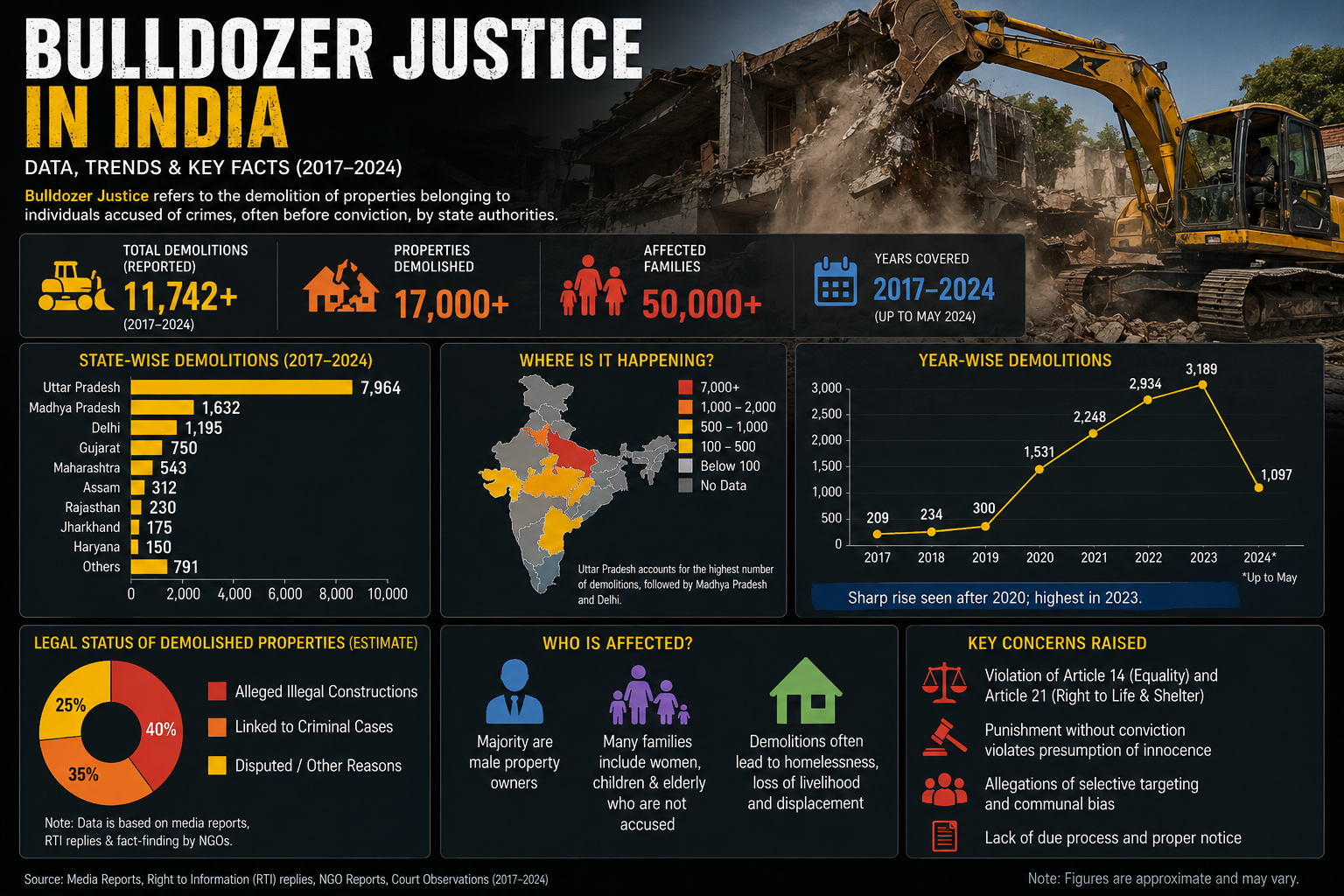
- The extrajudicial practice of state officials using heavy machinery, particularly bulldozers, to demolish the homes, businesses, or properties of people accused of crimes (such as riots, community violence, or significant felonies) is known colloquially as “bulldozer justice.”
- Although authorities sometimes defend these operations as “anti-encroachment campaigns” against unlawful constructions, the timing—typically just after a criminal accusation—has contributed to the perception that the executive branch is taking swift, punitive revenge.
- Key Characteristics
- Speed: Demolitions frequently take place 24 to 48 hours after a criminal occurrence, frequently prior to the start of a trial or the completion of a First Information Report (FIR).
- Executive Action: The police and local authorities make the choice, eschewing the judiciary’s function in establishing guilt and imposing punishment.
- Punitive Intent: Despite being presented as municipal enforcement, political leaders’ public discourse frequently presents it as a “lesson” for offenders, indicating a “tough on crime” approach.
- Systemic Delays as a Catalyst: A large backlog of cases over 5.5 crore and a poor judge-to-population ratio (15 judges per million Indians), in contrast to the 1987 Law Commission’s proposal of 50 judges per million, are the main causes of the desire for immediate justice.
What Are the Issues with Bulldozer Justice?
- Erosion of Due Process
- The disruption of the normal legal sequence—allegation → investigation → adjudication → punishment—is the most serious issue.
- By acting as “judge, jury, and executioner,” the executive branch circumvents the judiciary’s duty in establishing guilt by carrying out demolitions after an accusation.
- Collective Punishment
- Individual responsibility is the foundation of Indian criminal law. The Geneva Convention of 1949 and other international humanitarian norms forbid “collective punishment,” which includes making family members homeless as a method of punishment.
- Infringement of Fundamental Rights
- Right to Shelter (Article 21): The Supreme Court has held that the right to a decent place to live is part of the right to life (for example, in the Olga Tellis case from 1985). This fundamental right is violated by abrupt evictions without rehabilitation.
- Right to Property (Article 300A): Only the authority of the law, which requires a fair and reasonable method, may deprive someone of their property.
- Right to Equality (Article 14): Amnesty International and other critics have drawn attention to selective targeting, which involves demolishing the properties of particular neighborhoods or political dissidents while ignoring nearby municipal infractions.
- “Colourable” Use of Authority
- This is a “colourable” use of power, according to legal academics, in which the state utilizes a legitimate power (local control) for an illegal goal (punishing a crime). A demolition is unlawful when the main driving force behind it is a criminal accusation rather than a real urban planning infraction.
- Social Insecurity and Irreversible Damage
- Destroying a house and means of subsistence is frequently irrevocable, in contrast to a jail term that may be reversed or compensated. This leads to “domicide”—the deliberate demolition of homes—which makes underprivileged populations more vulnerable to trauma, terror, and social instability.
What are the major Indian court decisions on property demolitions?
- In Olga Tellis v. Bombay Municipal Corporation (1985), the Supreme Court ruled that evictions of pavement dwellers must follow a fair process. It is shown that the right to livelihood is a component of the right to life and that taking away someone’s place of residence essentially eliminates their capacity to make a living.
- In Chameli Singh v. State of UP (1996), the Supreme Court ruled that the right to shelter encompasses more than just “animal existence”; it also involves sufficient dwelling space, secure surroundings, and necessities.
- In Ahmedabad Municipal Corporation v. Nawab Khan Gulab Khan (1997), it was decided that although encroachers on public land have few rights, due process must nevertheless be adhered to.
- In Sudama Singh v. Government of Delhi (2010), the Delhi High Court held that the state must carry out a study and offer a significant rehabilitation plan before any eviction.
- According to K.T. Plantation (P) Ltd. v. State of Karnataka (2011), property deprivation under Article 300A must be carried out by a just, fair, and reasonable legal authority.
What are the Supreme Court Guidelines on Bulldozer Justice?
- No Demolition for Crime: There is no legal basis to destroy property based on alleged criminal activity.
- Mandatory Notice: Before acting, authorities must give at least 15 days’ notice via registered mail and affix it to the building.
- Right to Be Heard: Authorities must provide the impacted party a face-to-face hearing and issue a written, well-reasoned order explaining why destruction is the only practical course of action.
- Right to Appeal: The notification must allow the owner to contest the demolition in court or, if feasible, have the building regularized.
- Accountability and Personal Liability: All sessions must be videotaped, and officials who disobey these rules risk being charged with contempt of court and having their salaries withheld to provide reparations.
- Legal Exceptions: These guidelines do not apply to unapproved buildings on public property, such as highways, walkways, railroad tracks, or bodies of water, as well as situations in which a court has previously mandated the demolition.
How Can Institutional Protections Effectively Stop Bulldozer Justice Practices?
- Strict Implementation of Judicial Guidelines
- The strict implementation of the Supreme Court’s 2024 Pan-India Guidelines is the first step.
- These procedural “speed bumps”—such as a 15-day notice delivered to the owner and posted on the property—are intended to stop hasty retaliation acts.
- Judicial Vigilance
- Any demolition order can be automatically stayed by courts for a “cooling-off period” (for example, 15 days) so that the resident can pursue legal action.
- In order to consider claims for an immediate stay against demolition campaigns, High Courts may appoint Emergency Benches.
- Define Encroachment vs. Crime
- Legislation ought to explicitly separate criminal investigations from local law enforcement. Any municipal action against the accused’s property should be lawfully prohibited by a criminal accusation until an impartial survey is carried out.
- Stricter legislation requiring rehabilitation before eviction (as seen in the Sudama Singh case) makes the state’s arbitrary demolitions logistically and financially challenging.
- Establish Municipal Oversight Tribunals
- Establishing independent municipal tribunals is crucial to preventing the consolidation of absolute power within local civic organizations.
- In order to guarantee that municipal claims are subjected to an unbiased and objective evaluation prior to any action being taken, these quasi-judicial institutions would operate as an obligatory gatekeeper, screening all final demolition orders.
- Adopting United Nations Guidelines
- The United Nations Basic Principles and Guidelines on Development-Based Evictions and Displacement (2007) ought to be properly included in Indian legislation. This would guarantee that state-led demolitions are only allowed in conjunction with a thorough restoration plan and constitutionally forbid punishing forced evictions.
Conclusion
Bulldozer justice compromises basic rights, the separation of powers, and due process guaranteed by the Constitution. Extrajudicial demolitions entail collective punishment and lasting injury, notwithstanding the public’s legitimate irritation with judicial delays. Maintaining the rule of law requires strict adherence to the Supreme Court’s 2024 standards, which include required notice, hearing, and appeal measures.
Frequently Asked Questions (FAQs)
What does bulldozer justice mean?
Using municipal anti-encroachment campaigns as a pretext for punitive retaliation before trial, state officials demolish accused people’s properties in an extrajudicial manner.
In which seminal Supreme Court decision was the right to livelihood incorporated into Article 21 established?
According to Olga Tellis v. Bombay Municipal Corporation (1985), eviction without due process is against Article 21 because the right to livelihood is essential to the right to life.
What are the main points of the Supreme Court’s 2024 demolition guidelines?
No demolition for suspected crimes; a 15-day notice requirement; the right to an individual hearing and a reasoned order; the right to appeal; and the possibility of video recording and personal accountability for authorities who violate it.
Sources:
- https://en.wikipedia.org/wiki/Bulldozer_justice
- https://theloop.ecpr.eu/bulldozer-justice-punitive-populism-in-india/
- https://www.bbc.com/news/articles/c0k8d3ynvzxo
- https://www.thehindu.com/news/national/bulldozer-justice-simply-unacceptable-under-rule-of-law-says-supreme-court/article68851750.ece
- https://www.moneycontrol.com/news/india/bulldozer-action-what-is-it-who-started-it-why-sc-frowned-at-the-method-12813554.html
- https://indianexpress.com/article/explained/explained-law/what-supreme-court-said-about-bulldozer-justice-9668571/
Leave a Reply