

Criminalisation of Politics in India, 2026
Introduction
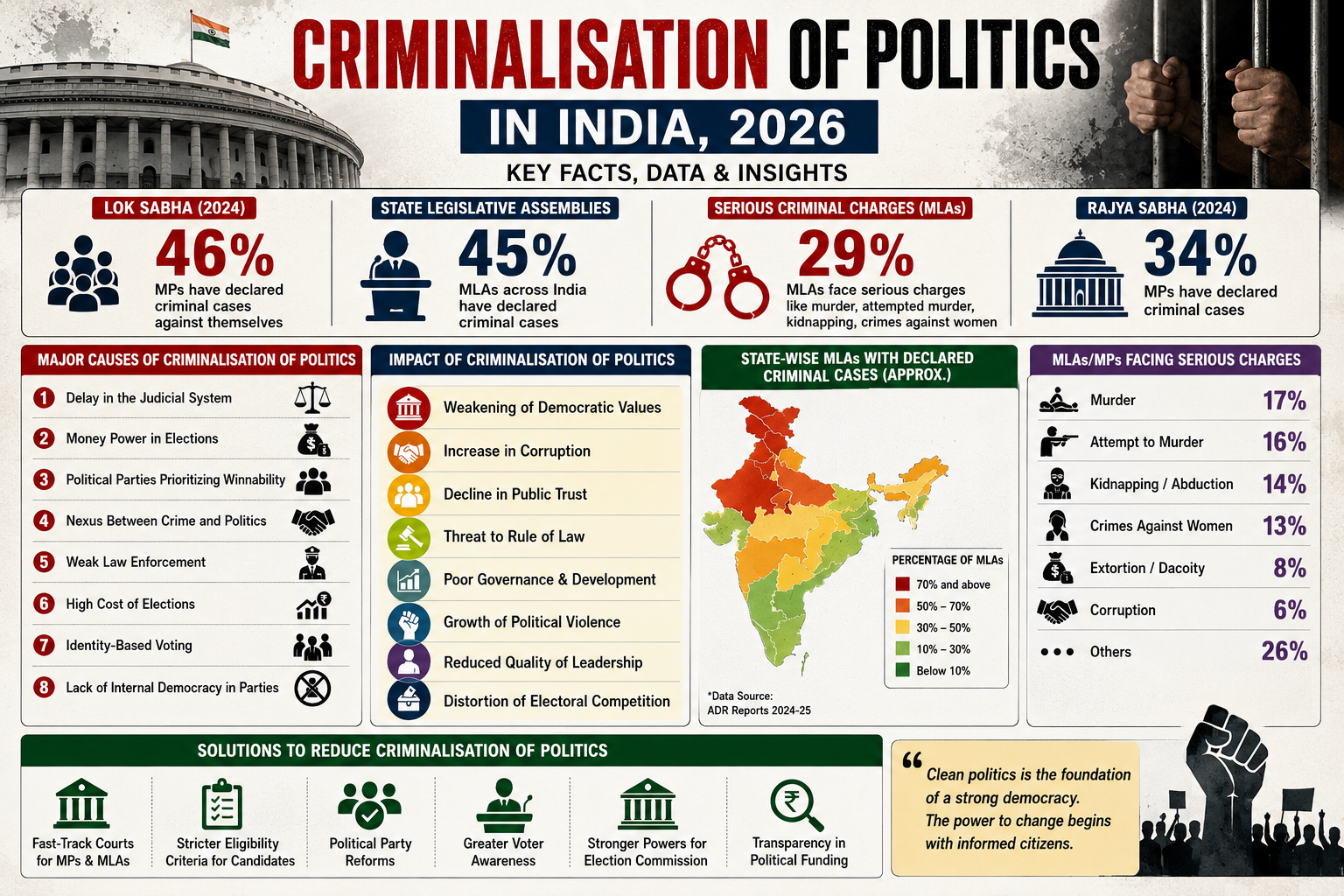
The Criminalisation of Politics remains one of the most serious threats to Indian democracy in 2026. According to a report by the Association for Democratic Reforms (ADR) and National Election Watch (NEW), 16% of current Rajya Sabha MPs face serious criminal charges, and 31% have declared criminal cases. This brings the crucial issue of the criminalisation of politics back into the public eye.
What are the Major Causes of Criminalisation of Politics?
- Delay in the Judicial System
- The poor speed of court proceedings is one of the main causes of the criminalisation of politics. Despite grave accusations, criminal proceedings against politicians frequently languish for years, enabling the accused to run for politics and hold public office.
- Money Power in Elections
- Significant financial resources are needed for election campaigns. Political parties looking for financially stable candidates find individuals with criminal records appealing since they frequently have substantial wealth or access to illicit funding sources.
- Political Parties Prioritizing Winnability
- Many political parties prioritize a candidate’s electoral success over their moral character or criminal history. Despite facing criminal accusations, candidates with financial resources, powerful networks, and local influence are frequently granted party tickets.
- Nexus Between Crime and Politics
- Politicians and criminals have built a tight relationship throughout time. Politicians may offer shelter from legal action in exchange for criminal organizations’ financial and physical support of political campaigns.
- Weak Law Enforcement
- Criminal elements frequently evade punishment and continue to engage in politics due to ineffective investigations, a lack of witness protection, political meddling, and lax prosecution procedures.
- High Cost of Elections
- Political parties are encouraged to depend on rich candidates due to the rising expense of running for office. People with criminal histories frequently have the financial means to cover these costs, which gives them an edge over candidates who are honest.
- Identity-Based Voting
- Voters in many areas place more weight on a candidate’s caste, religion, community, or local influence than their criminal history. Political parties are encouraged by this societal reality to nominate candidates who may use identity-based politics to generate support.
- Lack of Internal Democracy in Political Parties
- The majority of political parties lack open procedures for choosing candidates. Candidates with criminal histories may be nominated since decisions are frequently made by a small group of leaders.
- Low Political Awareness Among Voters
- Many voters either don’t know about a candidate’s criminal history or don’t think it matters while casting their ballot. Public pressure on political parties to field clean candidates is diminished by low awareness.
- Use of Muscle Power
- Candidates with criminal histories can employ local influence, extortion, and intimidation to win over voters. This fosters an atmosphere in which criminal groups acquire political clout.
What are the Impacts of Criminalisation of Politics?
- Weakening of Democratic Values
- Transparency, accountability, and the rule of law are the cornerstones of democracy. These ideals are compromised by the involvement of criminal elements in politics, which also erodes public trust in democratic institutions.
- Decline in Public Trust
- Citizens may lose faith in political leaders and governmental institutions when elected officials are charged with severe crimes. Public engagement in democratic processes may decline as a result of this erosion of trust.
- Increase in Corruption
- Corruption in government agencies, public initiatives, and the execution of policies can result from politicians with criminal records abusing their positions for personal benefit.
- Poor Governance
- The criminalization of politics frequently leads to poor governance and ineffective administration. Instead of tackling public needs like infrastructure, healthcare, and education, leaders may prioritize defending their own interests.
- Threat to Rule of Law
- The idea that political power can be utilized to evade legal responsibility is created when lawmakers themselves are charged with breaking the law. Respect for the legal system and judicial institutions is weakened as a result.
- Growth of Political Violence
- Election-related intimidation, coercion, and violence may be encouraged by criminal engagement in politics. Election competition that is free and fair is threatened by this.
- Misuse of Government Machinery
- To improve their political standing and avoid prosecution, people with criminal influence may take advantage of public resources, law enforcement organizations, and administrative authorities.
- Reduced Quality of Leadership
- Honest and competent people may be deterred from entering politics by the introduction of candidates with criminal backgrounds, which could lower the standard of political leadership as a whole.
What are the Findings of the ADR Report on Criminalisation of Politics?
- Prevalence of Criminal Cases
- Thirty-one percent of the 226 current Rajya Sabha MPs who were examined had criminal cases against them.
- 16% are charged with major crimes, such as murder, attempted murder, kidnapping, and crimes against women.
- According to the data, nearly all of the major national and regional political parties have a systematic problem with fielding candidates with criminal records.
- State-Wise Concentration
- The states with the highest percentage of MPs with declared criminal cases are Telangana (71%), Delhi (67%), and Maharashtra (53%).
- Concentration of Wealth
- Extreme wealth concentration in the Upper House was also addressed in the report. The average assets of a Rajya Sabha MP are an astounding Rs 120.69 crore, and almost 14% of MPs are billionaires.
- Implications for Indian Polity
- The ADR study emphasizes how deeply ingrained the criminal-politician-business relationship is, a problem that the Vohra Committee officially acknowledged thirty years ago (1993).
- The “House of Elders” has significant ramifications when people with extreme wealth and criminal histories are admitted.
- Legislators who are facing severe criminal accusations may purposefully weaken institutional accountability mechanisms or sway legislation to suit their own objectives.
- According to the Constitution, the Rajya Sabha is intended to represent state interests and offer knowledgeable legislative scrutiny. This mandate is undermined by the dominance of the “winnability” factor, which is motivated by power and money.
What is the Criminalisation of Politics?
- About
- The concerning trend of people with criminal histories, pending charges, or convictions taking part in state political and electoral processes, running for office, and serving in state and federal legislatures is known as “criminalization of politics.”
- This phenomenon seriously erodes the democratic ethos by undermining the integrity of public institutions and substituting the rule of money and force for the rule of law.
- Causes of Increasing Criminalisation
- The “Winnability” Factor
- Election results are what motivate political parties. According to data, candidates with criminal histories have a much higher success percentage (about 15%) than those with spotless records (around 4%).
- In order to self-finance campaigns, criminals bring their own illicit resources.
- Money and Muscle Power
- Parties are forced to rely on candidates who have substantial black money reserves and the physical “muscle” to threaten opponents, take over polling places (historically), and influence voters due to the First-Past-The-Post (FPTP) electoral system and the high expense of elections.
- Governance Deficit
- Many voters favor strongmen with criminal histories because of weak state institutions and inadequate public service delivery. These individuals serve as parallel power centers and offer speedy, extralegal remedies.
- Legal Loopholes and Slow Justice
- A person convicted of specific offenses and sentenced to two years or more in prison is prohibited from running for office under Section 8 of the Representation of the People Act, 1951. This disqualification lasts for six years following the completion of the sentence.
- Candidates with ongoing criminal prosecutions, however, are not disqualified by the Act and may run for office until they are found guilty.
- Politicians can easily complete many legislative terms despite spending decades fighting trials due to the slow Indian court system, which has a backlog of over 5.6 crore pending cases. They are still able to contest even if the charges are just framed.
- Identity Politics and Vote Banks
- Voters often give restricted communal interests—like caste, religion, or language—priority over a candidate’s criminal history.
- In order to safeguard and support their particular vote banks, local strongmen are sometimes viewed as “Robin Hood” characters who can cut through bureaucratic red tape.
- The “Winnability” Factor
- Ethical Implications of Criminalisation of Politics
- The criminalization of politics promotes a culture of impunity where winning elections takes precedence over moral behavior, undermining nonpartisanship, accountability, and constitutional morality.
- It undermines democratic accountability, erodes public confidence, uses money and physical force to skew free and fair elections, and marginalizes women’s empowerment by turning representation into symbolic rather than actual empowerment.
- In the end, it impedes India’s democratic and developmental goals by undermining the rule of law, transparency, institutional integrity, and inclusive development.
What Reforms are Needed to De-Criminalisation of Politics in India?
- N.N. Vohra Committee (1993)
- Acknowledged the presence of a rival government that was controlled by criminal organizations and mafias who benefited from political favors.
- It suggested establishing a dedicated Nodal Agency under the Ministry of Home Affairs to collect intelligence and monitor the operational connections and financial traces of the criminal-politician-business nexus.
- Dinesh Goswami Committee (1990) & Indrajit Gupta Committee (1998)
- Both committees were ardent supporters of the state providing recognized political parties with partial in-kind money for elections.
- Parties would be less reliant on the “black money” and financial clout supplied by criminal candidates if the state paid for necessary campaign supplies (voter slips, fuel, and media time).
- Second Administrative Reforms Commission (2nd ARC, 2008)
- According to the ARC’s study on “Ethics in Governance,” Section 8 of the RPA should be amended to promptly disqualify anyone who is on trial for major crimes.
- stressed that to maintain institutional integrity, ministers and legislators must adhere to a strict code of ethics.
- 244th Law Commission Report (2014)
- When a court files charges for offenses carrying a sentence of five years or more in prison, the Commission advised dismissing candidates as long as the charges are filed at least a year before nominations are reviewed.
- In order to guarantee the prompt resolution of criminal cases involving politicians, it also suggested daily trials through special fast-track courts and increased penalties for filing false electoral affidavits, including a minimum two-year jail sentence and direct disqualification.
- Law Commission (255th Report, 2015)
- Strict financial transparency was advised, along with independent party account audits and the disclosure of all political contributions, regardless of size.
- Election Commission’s Core Proposals
- Instead of the present six-year disqualification following release, the Election Commission of India (ECI) has petitioned the Supreme Court to impose a lifetime ban on convicted politicians from running for office.
- Enhancing Voter Awareness
- Voters must be vigorously informed about the backgrounds of their candidates by the Election Commission of India (ECI) and civil society. Parties may be compelled to field cleaner candidates due to electoral need if widespread awareness and the NOTA (None of the Above) option are combined.
Conclusion
A crisis of constitutional morality is reflected in the criminalisation of politics, which echoes Dr. B.R. Ambedkar’s caution that even a fine Constitution fails if it is run by a “bad lot.” Building strong state capability is necessary for true reform, which goes beyond judicial orders and reactionary legislation. In the end, decriminalizing politics is essential to guaranteeing that the rule of law triumphs over the rule of force, not just to sanitize the legislature.
Frequently Asked Questions (FAQs)
What does it mean to criminalize politics?
It refers to the growing number of people with criminal histories participating in elections and legislative bodies, which threatens democratic government and the rule of law.
What is included in Section 8 of the 1951 Representation of the People Act?
It disqualifies lawmakers not just on the basis of the charges, but also upon conviction for certain offenses, usually those carrying a term of two years or more.
What were the main suggestions made in the 244th Law Commission Report (2014)?
It suggested fast-track courts for cases involving politicians, harsher penalties for fraudulent affidavits, and disqualification upon filing charges for significant offenses.
What is the purpose of the 2025 Constitution (130th Amendment) Bill?
Concerns about the presumption of innocence and possible political abuse are raised by the Bill, which aims to remove Ministers—including the Prime Minister and Chief Ministers—if they are detained for 30 days in a row for crimes carrying a sentence of five years or more.
Sources:
- https://www.thehinducentre.com/verdict/get-the-fact/criminalisation-of-politics/article64936366.ece
- https://www.eci.gov.in/about-eci
- https://indianexpress.com/article/opinion/columns/criminalisation-of-politics-must-be-curbed-7451116/
- https://www.newindianexpress.com/india/2025/Feb/10/criminalisation-of-politics-is-a-very-major-issue-says-sc-on-pil-seeking-lifetime-ban-for-convicted-mps-mlas
- https://economictimes.indiatimes.com/news/politics-and-nation/pil-demands-lifetime-ban-on-convicts-from-polls-supreme-court-seeks-eci-centre-views/articleshow/118125932.cms?from=mdr
Leave a Reply