

What is US-China Summit 2026?
Introduction
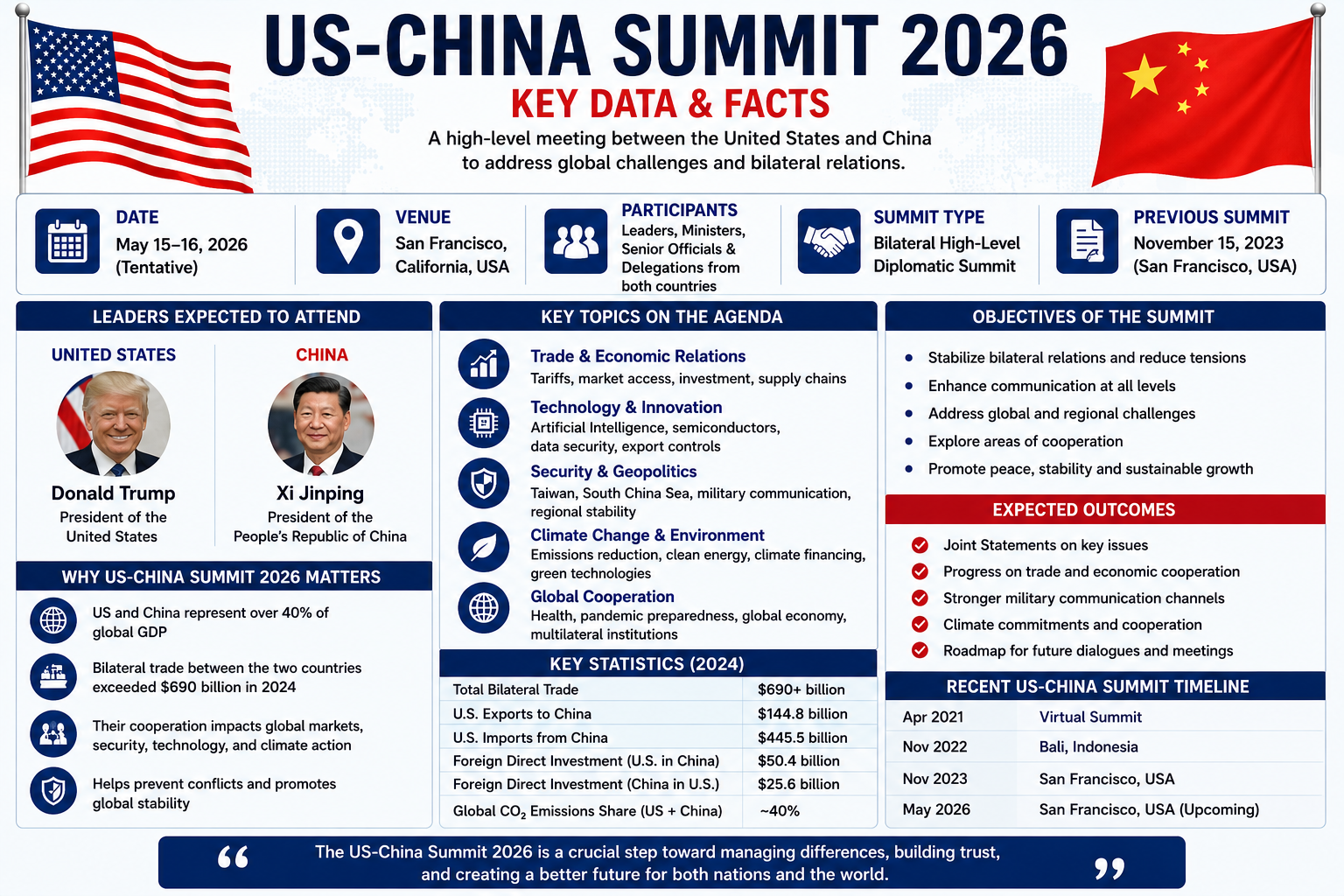
The mid-May US-China summit 2026, often referred to by experts as the “Stalemate Summit,” ended with a focus on transactional, tactical agreements and a mutual desire for short-term stability rather than any substantial settlement to structural concerns. The diplomatic reset between the two giants has formed a new vision for strategic stability, with major structural consequences for global markets and regional dynamics in Asia, following the US President’s high-profile visit to China following a nine-year break.
What are the outcomes of the US-China Summit 2026?
- Economic Compromises & Trade Deals
- Over three years (until 2028), China promised to buy at least USD 17 billion in US agricultural products, including American beef and soybeans.
- China gave the US manufacturing industry a significant boost when it authorized an initial contract to purchase 200 Boeing aircraft manufactured in the United States.
- To resolve ongoing tariff issues and enhance their economic cooperation, the two countries decided to establish two new institutional mechanisms:
- The US-China Board of Trade will oversee and promote trade in non-sensitive goods.
- Investment regulations and non-tariff barriers will be discussed on the US-China Board of Investment.
- Technology & Critical Minerals
- The US made a significant compromise by allowing ten Chinese companies to start buying cutting-edge Nvidia H200 processors again. These chips are essential for frontier tech research, high-performance computing, and artificial intelligence. However, stringent export restrictions still apply to sophisticated lithography equipment.
- The United States demanded guarantees of a consistent supply of essential minerals, including indium, neodymium, and yttrium.
- Strategic Stability & “The Thucydides Trap”
- The Chinese president presented a vision that calls for major-power relations to be guided over the coming years by a “constructive relationship of strategic stability.” To avoid unintentional conflict, the framework seeks to maintain competition within reasonable bounds.
- Chinese leadership framed the conference as an effort to erect diplomatic barriers, emphasizing the significance of avoiding the Thucydides Trap, the historical propensity toward war when a rising power challenges an established one.
- Geopolitical Flashpoints & Friction Areas
- The leaders emphasized a common objective that Iran must not obtain nuclear weapons and found rhetorical agreement on the significance of maintaining the Strait of Hormuz open to international shipping. China, meanwhile, made no firm public pledges to support the US in exerting economic or diplomatic pressure on Iran.
- With severe warnings that any “mishandling” of the democratic island could lead to direct conflict, the Chinese president firmly re-centered the Taiwan problem. Long-standing geopolitical strategy remained unsettled as a result of the US administration’s significant avoidance of deeper structural commitments on this front.
- People-to-People Exchange
- Serving as the “lubricant” for the partnership, the leaders promoted China’s 2023 plan to send 50,000 young Americans to China over five years; more than 40,000 of them have already finished exchange programs.
What effects might the 2026 US-China Summit have on India?
Concerns
- Dilution of India’s Strategic Leverage
- India’s position as a vital Indo-Pacific counterweight to an assertive Beijing has been linked to its geopolitical premium in Washington for the last ten years.
- Even a short-term, three-year managed truce would reduce India’s immediate negotiating leverage for highly concessionary weapons transfers and privileged intelligence cooperation.
- Minilateral frameworks like the Quad (US, India, Japan, and Australia) run the risk of losing momentum if the US moves toward direct, bilateral agreements to deal with Beijing.
- A transactional duopoly (Risk of a “G2” Bilateralism) where Washington and Beijing avoid multilateral venues is indicated by the establishment of a bilateral Board of Trade and shared AI Safety Channels.
- Erosion of the “China-Plus-One” Strategy
- India has established itself as the top location for international investors seeking to reduce risk by moving away from supply networks that are mostly focused on China.
- The stark cost differences that prompted multinational firms to actively seek out alternatives are stabilizing as trade conflict between the US and China decreases. Businesses may reassess China more favorably at the margin if they want to deploy their supply chains in 2026–2027.
- It may reduce the amount of foreign direct investment (FDI) that enters India’s advanced manufacturing, semiconductor, and electronics industries.
- Complications in the Middle East and Energy Security
- Although India, a major importer of oil, benefits from US-China cooperation to sustain global energy flows, the transactional structure of the agreement means India cannot rely on great-power safeguards.
- India’s major initiatives in the Persian Gulf, such as the Chabahar Port and the India-Middle East-Europe Economic Corridor (IMEC), may be marginalized or deprioritized if the US significantly depends on China to mediate calm in the region.
- Beijing’s long-term maritime security and anti-piracy leadership in the Western Indian Ocean are squarely at odds with the US-approved expansion of Beijing’s position in West Asia.
- Emboldened China on the Border
- China may see less international pressure now that the Chinese President has been acknowledged globally as an equal peer to the United States. This might make India’s long-term, autonomous military and diplomatic attempts to ease the Line of Actual Control (LAC) impasse more difficult.
- Washington might overlook Beijing’s downstream military-technical transfers to Pakistan if US foreign policy is solely focused on transactional economics with China. This would unintentionally increase India’s long-term, multi-front defense burden.
Opportunities
- Sustaining Strategic Autonomy
- India has more space to further its own interests when the US-China relationship is less divisive. Through organizations like the G20 and BRICS, India can actively serve as a major mediator for the Global South while maintaining its strong strategic and energy links with Russia.
- Accelerated Border Indigenization
- India has additional motivation to increase its internal defense production (Atmanirbhar Bharat) and strengthen vital border infrastructure along the LAC since it understands that foreign alignments can be unstable.
- Push for Independent Trade Pacts
- India is encouraged to quickly adopt independent economic alliances, such as early implementation of the India-EU Free Trade Agreement (FTA) and strengthening tech-industrial ties with Northern European countries like Sweden, rather than depending exclusively on US market access.
How might India respond to the challenges posed by the US-China Summit?
- Strategic Autonomy 2.0 and Multi-Alignment
- If the US and China are using a transactional duopoly to manage their conflict, India needs to develop several separate centers of power rather than being driven into a binary decision.
- India should strengthen its defense, energy, and strategic ties with Russia. A powerful Russia guarantees that India maintains a crucial overland strategic anchor in Eurasia and will not entirely slide into China’s orbit.
- By developing high-tech defense and green industry connections with independent technological hubs like Sweden (via the SITAC and LeadIT frameworks), France, and Germany, India needs to look outside the US.
- In order to preserve a free and open Indo-Pacific, independent of shifting political tides in Washington, India should increase bilateral military and marine cooperation with Japan, Australia, and ASEAN countries (such as Vietnam and the Philippines) while continuing to interact with the Quad.
- Tactical De-escalation with China
- India shouldn’t continue to be the only front-line state engaged in active conflict with China when the US is reducing its combative stance with Beijing. In order to handle border conflicts bilaterally without anticipating outside US intervention, India should maintain a strong defense posture while maintaining diplomatic lines open with Beijing.
- India should build its enormous Frontier Highway and related connecting corridors along its northern frontiers much more quickly. Beijing will be forced to acknowledge that a localized conflict would have an uneven economic and military cost if the borders are stabilized by unquestionable internal strength and quick military deployment capacity.
- In non-sensitive, high-growth manufacturing areas (such as solar components or electronics assembly), where input costs can boost Indian producers and build domestic export capacities, India may choose to allow Chinese FDI.
- Sovereign Manufacturing Hub
- India needs to actively address its internal structural barriers in order to stop international money from returning to China as a result of reduced US-China trade tensions.
- India must expedite labor, land, and logistical reforms in order to reduce the cost of doing business and become more competitive with China than merely a “default alternative.”
- India must increase indigenous research and production in vital components, such as semiconductors, advanced electronics, and electric vehicle (EV) supply chains, through improved Production Linked Incentive (PLI) programs rather than depending solely on Western tech transfers.
- India must use its membership in the US-led Mineral Security Partnership (MSP) to break away from Chinese refinery monopolies while simultaneously forming independent processing alliances with resource-rich countries like Brazil to get deep-tech minerals (neodymium, indium, and lithium).
- Consolidating Leadership of the Global South
- In order to prevent a US-China “G2” duopoly from marginalizing the interests of the Global South, India should actively use BRICS and the Shanghai Cooperation Organization (SCO) to create global financial and regulatory systems.
- India may offer transparent, sustainable development assistance and digital public infrastructure, such as UPI, to African, Latin American, and island states as an alternative to China’s heavily indebted Belt and Road Initiative (BRI).
- Atmanirbhar Bharat in Defence and Space
- Reliance on foreign superpowers for national security is unstable, as seen by the US-China relationship. India needs to guarantee complete defense independence.
- For expensive items like multi-role fighter aircraft (such as the ongoing request for proposals for 114 multi-role fighter aircraft) contracts and air-independent propulsion (AIP) systems for submarines, India must mandate 100% technology transfers and drastically shorten its bureaucratic defense procurement cycles.
Conclusion
The US-China Summit 2026 marked an important diplomatic reset between the world’s two largest economies, focusing on trade, technology, and strategic stability. While it eased short-term tensions, deeper geopolitical issues remain unresolved. For India, the summit brings both challenges and opportunities, making strategic autonomy, stronger domestic manufacturing, and balanced global partnerships more important than ever in a changing world order. India’s role as the main Indo-Pacific balancer is being challenged by the 2026 U.S.-China transactional truce, which represents a significant shift toward a controlled duopoly.
Frequently Asked Questions (FAQs)
What is the US-China Summit 2026?
The US-China Summit 2026 was a high-level diplomatic meeting between the United States and China focused on trade, technology, and reducing geopolitical tensions between the two nations.
What were the key outcomes of the US-China Summit 2026?
The summit resulted in trade agreements, cooperation on critical minerals and technology, and discussions on maintaining strategic stability and avoiding conflict.
How does the US-China Summit 2026 affect India?
The summit may reduce India’s strategic leverage with the US, but it also creates opportunities for India to strengthen strategic autonomy and boost domestic manufacturing.
Why is the US-China Summit 2026 important globally?
It is important because decisions taken by the US and China influence global trade, supply chains, energy security, and geopolitical stability across the world.
What should India do after the US-China Summit 2026?
India should focus on strategic autonomy, stronger defense self-reliance, independent trade partnerships, and expanding its leadership role in the Global South.
Sources:
- https://www.whitehouse.gov/fact-sheets/2026/05/fact-sheet-president-donald-j-trump-secures-historic-deals-with-china-delivering-for-american-workers-farmers-and-industry/
- https://www.csis.org/programs/trump-xi-2026-summit
- https://thediplomat.com/2026/05/the-us-china-summit-from-a-japanese-perspective/
- https://www.conference-board.org/research/ced-policy-backgrounders/us-china-summit-and-the-future-of-us-policy-in-taiwan
- https://en.wikipedia.org/wiki/2026_state_visit_by_Donald_Trump_to_China
- https://www.cnbc.com/2026/05/18/us-china-announce-deals-after-trump-xi-summit.html
- https://www.bbc.com/news/articles/clypj01189lo
Leave a Reply