

Untouchability in India: Challenges, Laws and Impact, 2026
Introduction
Despite constitutional guaranties of equality and dignity, untouchability continues to be one of India’s most significant societal issues. After its use by Dalit people, a “purification” (Shuddhikaran) rite at a public location in Haldwani, Uttarakhand, has spurred discussion over the constitutional ban on untouchability under Article 17.
What is Untouchability?
- The social practice of perceiving particular people or communities as inferior because of their caste identity is known as “untouchability.” In the past, access to public spaces, temples, wells, schools, and other community resources was restricted for members of Scheduled Castes (SCs), often known as Dalits.
- Article 17 of the Indian Constitution outlawed untouchability and made its practice unlawful and punished by law.
- Untouchability might not always exist in its conventional form today. Rather, it frequently takes the form of discrimination in the workplace, social isolation, village segregation, unfair treatment in schools, and hate speech on the internet.
What is the Historical Background of Untouchability in India?
- The strict caste system that developed over generations is the source of untouchability. Occupations deemed “impure” by society were allotted to specific communities. These communities were consequently deprived of fundamental human rights and social equality.
- Caste discrimination was fiercely resisted by social reformers and politicians during the colonial era. Prominent individuals like Dr. B. R. Ambedkar devoted their lives to combating untouchability and obtaining equal rights for underprivileged groups.
- The Indian freedom movement also understood that social equality was a prerequisite for political independence. As a result, the Constitution’s writers added strict clauses to end discrimination based on caste.
What are Constitutional Provisions Against Untouchability?
- Article 14: Equality Before Law
- All citizens, regardless of caste or socioeconomic standing, are guarantyd equality before the law and equal protection under the law under Article 14.
- Article 15: Prohibition of Discrimination
- Discrimination on the basis of religion, ethnicity, caste, sex, or place of birth is forbidden by Article 15.
- Article 16: Equality of Opportunity
- Article 16 permits affirmative action for socially disadvantaged populations and guaranties equal opportunity in public employment.
- Article 17: Abolition of Untouchability
- Untouchability is outlawed and its practice in any form is prohibited, according to Article 17. The legislation penalizes any handicap resulting from untouchability.
- Article 21: Right to Life and Dignity
- Caste-based humiliation and exclusion are incompatible with fundamental ideals, according to the Supreme Court’s interpretation of Article 21, which includes the right to live with dignity.
What are the Major Laws Addressing Untouchability?
- Protection of Civil Rights Act, 1955
- This law was eventually renamed the Protection of Civil Rights Act after it was first passed as the Untouchability (Offenses) Act. It makes actions resulting from untouchability illegal and imposes punishments on violators.
- SC/ST (Prevention of Atrocities) Act, 1989
- In order to stop atrocities and caste-based violence against Scheduled Castes and Scheduled Tribes, this law was enacted. It creates special courts for prompt justice and imposes harsh penalties.
- Prohibition of Employment as Manual Scavengers and Their Rehabilitation Act, 2013
- The law aims to rehabilitate impacted workers and end manual scavenging. Courts have frequently connected manual scavenging to untouchability and discrimination based on caste.
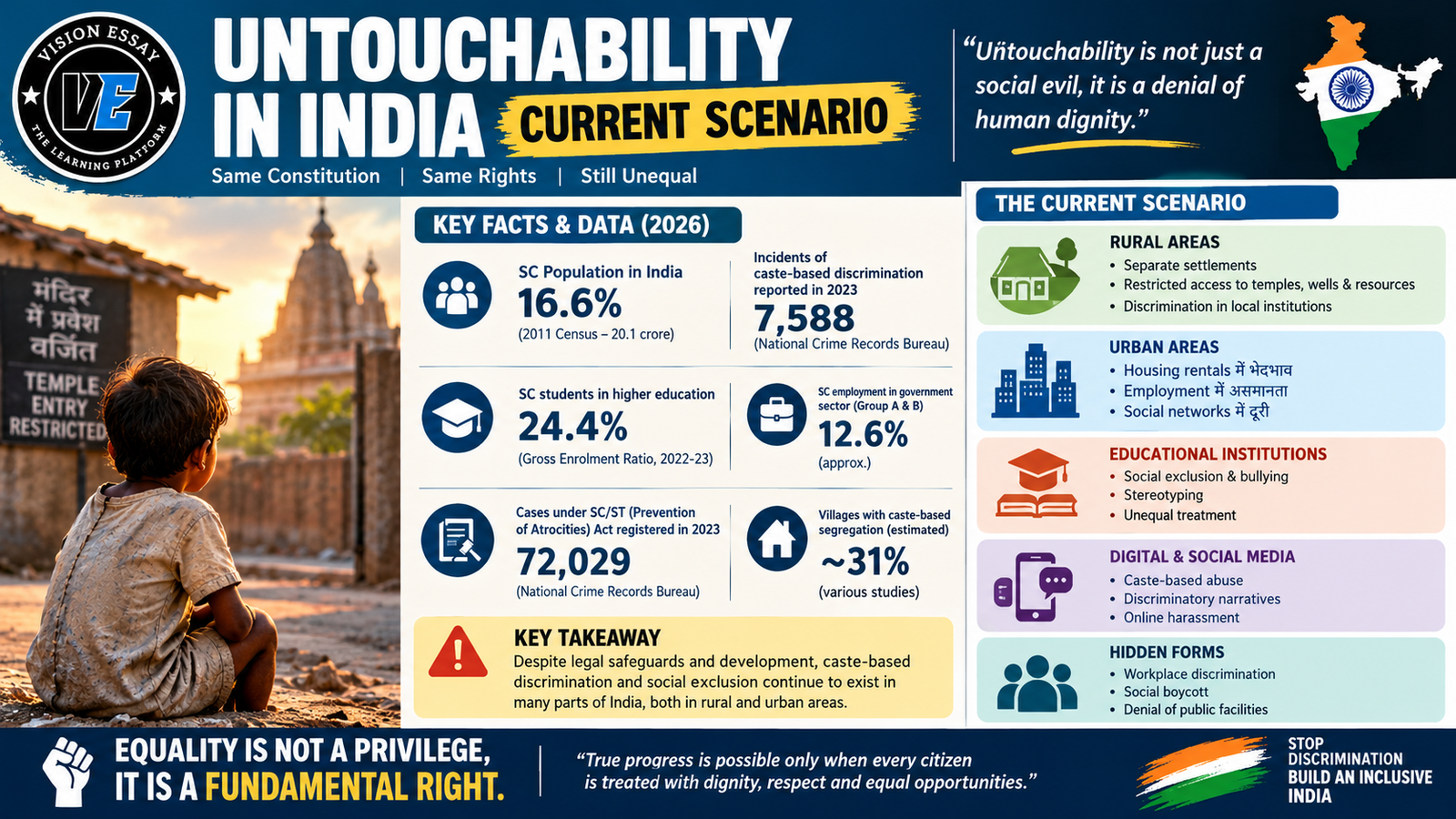
What are Current Scenario of Untouchability in India?
- Social Segregation
- People are still divided along caste lines in a number of areas by distinct villages, communal areas, and social customs. Festivals, marriages, and communal gatherings might nevertheless result in social marginalization.
- Educational Discrimination
- Reports of caste-based bullying, discrimination, and exclusion in schools and higher education institutions persist even though access to education has greatly improved.
- Workplace Discrimination
- Workers from underrepresented groups may experience subtle kinds of discrimination, unfair treatment, and obstacles to professional growth.
- Digital Untouchability
- Social media has given people more ways to express themselves, but it has also made it possible for prejudice and abuse based on caste to proliferate quickly.
- Manual Scavenging
- The practice of manual scavenging has persisted despite legislative bans. Concerns about its existence are still voiced by activists and human rights organizations.
- Violence and Atrocities
- In certain regions of India, caste-based violence is still a major problem. Such examples show that ingrained societal biases cannot be eradicated by legal abolition alone.
What are Supreme Court’s Role in Interpreting Untouchability?
- Indian courts have continuously broadened the definition of untouchability to include more than just physical exclusion.
- The Supreme Court has stressed that private people who engage in discriminatory acts are likewise subject to Article 17. According to courts, untouchability is a result of the caste system and an indirect form of slavery.
- The question of whether activities based on ideas of caste-based cleanliness and contamination might amount to untouchability under Article 17 has also been the subject of recent constitutional debates. Legal experts contend that discrimination based on concepts of ritual impurity is included in the constitutional ban, which goes beyond denial of access.
What is the Impact of Untouchability on Society?
- Indian society has been profoundly and permanently impacted by untouchability. It established a system of social discrimination in which some communities—Dalits in particular—were denied fundamental human rights and viewed as inferior. Inequality in housing, work, education, and access to public spaces like temples, wells, and schools resulted from this practice.
- People became divided and the nation’s cohesiveness was undermined by the social isolation brought about by untouchability. Millions of people lost out on chances for both economic and personal development as a result, which led to poverty and societal regression. Because victims frequently experienced shame, loss of dignity, and diminished self-confidence, the psychological impacts were as detrimental.
- Even though Article 17 of the Indian Constitution outlawed untouchability and other laws were passed to protect underprivileged groups, there are still remnants of this practice in some places.
- It will need ongoing efforts to eradicate untouchability via societal awareness, education, and rigorous legal enforcement. Achieving real equality, social peace, and inclusive growth requires a society devoid of discrimination.
What are the Challenges in Eliminating Untouchability?
- Untouchability continues to be a major social challenge in India despite constitutional provisions and legal safeguards. The primary obstacle is the deep-rooted caste system, which has shaped social attitudes and practices for centuries. In many rural areas, caste-based discrimination remains prevalent due to traditional beliefs and social hierarchies.
- Lack of awareness about legal rights and anti-discrimination laws further hinders efforts to eradicate untouchability. Victims often avoid reporting incidents because of fear of social exclusion, threats, or violence. Economic dependence on dominant caste groups also discourages resistance against discriminatory practices.
- Although laws such as the Protection of Civil Rights Act, 1955 and the SC/ST (Prevention of Atrocities) Act, 1989 prohibit such practices, weak implementation and delays in the justice system reduce their effectiveness. Additionally, limited access to quality education and employment opportunities keeps marginalized communities vulnerable.
Conclusion
In India in 2026, untouchability is still a major societal problem despite legal safeguards and constitutional guaranties. Untouchability was outlawed by Article 17, and the battle against discrimination based on caste has been reinforced by further legislation. However, discrimination, injustice, and social isolation still plague many communities.
Frequently Asked Questions (FAQs)
What is Untouchability in India?
Untouchability is a form of caste-based discrimination in which certain communities are treated as socially inferior and excluded from equal participation in society. It was abolished by Article 17 of the Indian Constitution.
Is Untouchability still practiced in India in 2026?
Although legally prohibited, Untouchability continues to exist in some areas through social exclusion, caste discrimination, segregation, and unequal access to opportunities and public resources.
Which law prohibits Untouchability in India?
Article 17 of the Constitution abolishes Untouchability. The Protection of Civil Rights Act, 1955 and the SC/ST (Prevention of Atrocities) Act, 1989 provide legal protection against caste-based discrimination and atrocities.
What are the major effects of Untouchability on society?
Untouchability leads to social inequality, human rights violations, economic exclusion, psychological distress, and reduced opportunities for affected communities, ultimately hindering national development.
How can India completely eliminate Untouchability?
India can eliminate Untouchability through quality education, strict enforcement of laws, social awareness campaigns, economic empowerment of marginalized communities, and promotion of constitutional values such as equality and dignity for all.
Sources:
- https://www.lawjournals.org/assets/archives/2017/vol3issue4/3-4-28-129.pdf
- https://humanrightshouse.org/articles/india-widespread-practice-of-untouchability/
- https://ijlmh.com/paper/untouchability-a-reality-check/
- https://www.cambridge.org/core/books/abs/why-representation-matters/untouchability-in-rural-india/03935ABFBBBA5B46C3727320BE4BF33B
- https://cjp.org.in/exploring-the-legal-framework-against-untouchability-in-india-a-comprehensive-analysis-of-recent-data-and-socio-legal-implications/
- https://www.thehindu.com/news/national/untouchability-and-the-idea-of-purity/article71415040.ece
- https://en.vikaspedia.in/viewcontent/social-welfare/social-awareness/caste-system-in-india?lgn=en
Leave a Reply