

Delimitation Bill in India, 2026
Introduction
One of the most important political and constitutional debates in the nation is the Delimitation Bill in India, 2026. Delimitation is a topic of discussion among political parties, state governments, constitutional scholars, and individuals as India gets ready for the first significant readjustment of parliamentary constituencies in decades. As the Centre works to bring back its proposed electoral changes in advance of the 2029 Lok Sabha elections, the delineation of Lok Sabha seats has once again emerged as a significant political issue.
What is the Delimitation Bill?
- About
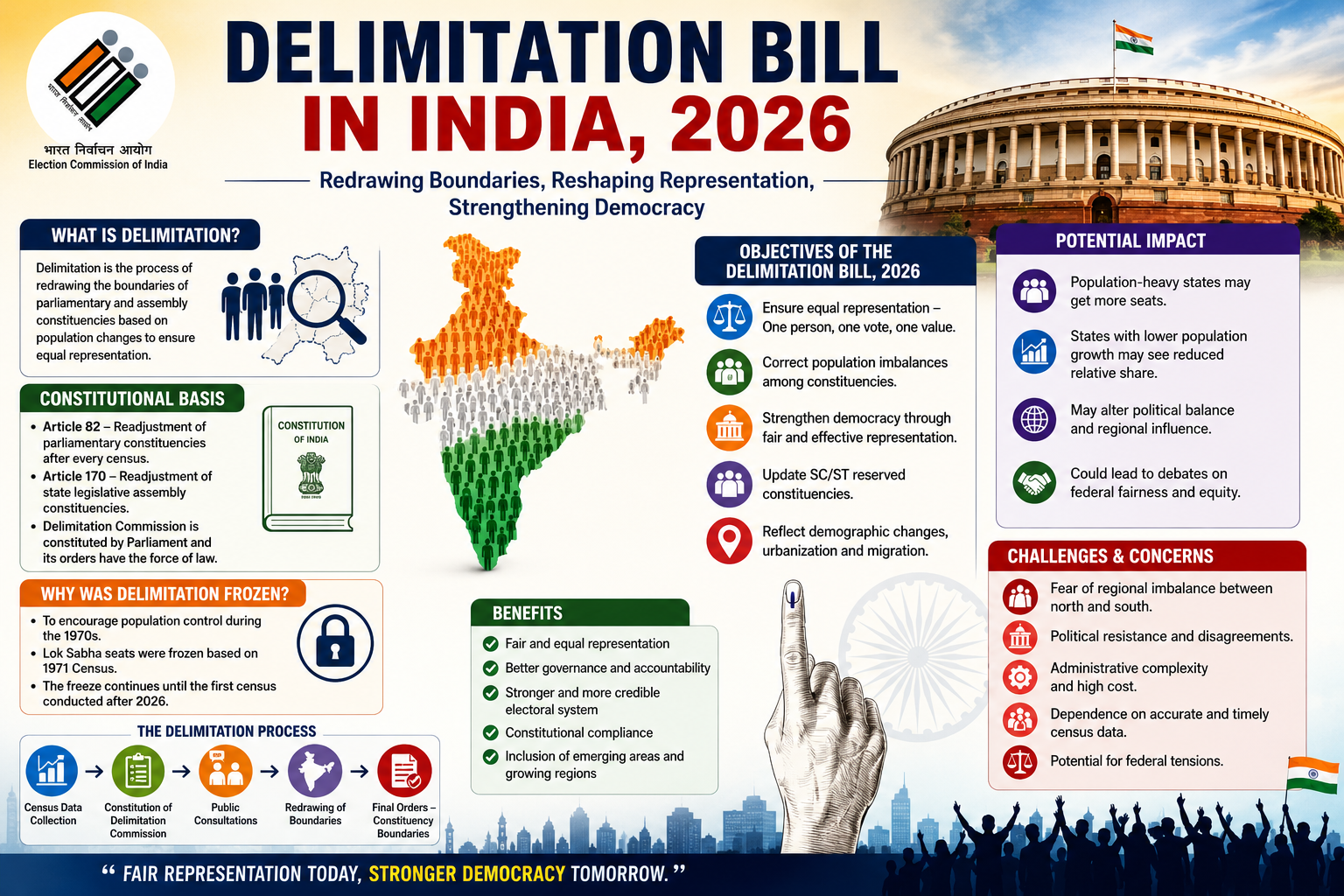
- The process of establishing or redrawing the borders of geographical constituencies for the Lok Sabha and State Legislative Assemblies to guarantee that each seat represents a nearly equal number of votes is known as delimitation.
- Objective
- To implement the democratic ideal of “one person, one vote, one value” by modifying borders in response to changes in population concentrations over time.
- Establishes special seats for Scheduled Tribes (ST) and Scheduled Castes (SC) to guarantee marginalized groups’ political presence.
- Constitutional Basis of Delimitation
- According to Article 82, Parliament may pass a Delimitation Act to reorganize parliamentary seats following each census.
- Following each census, state legislative assembly districts are readjusted in accordance with Article 170.
- Delimitation Commissions in India
- It is a powerful, autonomous organization with three members: the State Election Commissioners of the relevant states, the Chief Election Commissioner (or an Election Commissioner recommended by them), and the Chairperson, who may be a sitting or retired Supreme Court judge.
- Delimitation orders are often protected from court intervention and have statutory finality. However, the Supreme Court ruled in the Kishorchandra Chhanganlal Rathod case (2024) that if a Delimitation Commission ruling is blatantly arbitrary or goes against constitutional principles, it may be susceptible to limited judicial review.
- Up until March 2026, it was established four times under the corresponding Delimitation Acts in 1952, 1963, 1973, and 2002.
- According to Article 329(a), no court may examine the legality of any legislation about the allocation of seats or the delineation of districts adopted under Article 327.
- Freeze on Delimitation
- In order to prevent states that used population control measures—mostly in the South—from being punished with lower parliamentary representation, the 42nd Amendment Act, 1976 froze the total number of seats in the Lok Sabha based on the 1971 Census.
- The 84th Amendment Act of 2001 extended the cap on the overall number of seats until the first census after 2026.
- The interstate distribution of seats is still based on data from 1971, even tho the 2002 Commission redrew internal borders within states (based on the 2001 Census).
What are Key Objectives of the Delimitation Bill in India, 2026?
- Ensuring Equal Representation
- Ensuring that every citizen’s vote has equal weight regardless of where they reside is the main goal.
- Population changes have led to significant differences between constituencies throughout time.
- Redraw Electoral Boundaries
- In order to reflect contemporary demographic realities, the Bill seeks to alter the borders of Lok Sabha and State Assembly constituencies using updated population statistics.
- Remove the Long-Standing Seat Allocation Freeze
- It aims to lift the Lok Sabha seat readjustment freeze that has been in place since the 1970s and was prolonged till beyond 2026.
- Increase the Size of the Lok Sabha
- In order to better represent India’s expanding population, the Bill suggests increasing the Lok Sabha’s maximum number of members from 550 to 850.
- Establish a New Delimitation Commission
- It calls for the establishment of an impartial Delimitation Commission, which will be in charge of redrawing constituency lines and assigning seats.
- Implement Women’s Reservation
- Operationalizing the 33% reservation for women in the Lok Sabha and State Legislative Assemblies, as required by the 106th Constitutional Amendment, is a primary goal.
- Reallocate Reserved Seats
- Based on population distribution, the Commission will decide which seats are set aside for women, Scheduled Tribes (STs), and Scheduled Castes (SCs).
- Strengthen Democratic Governance
- The Bill seeks to make India’s democratic institutions more adaptable to current demographic trends and governance requirements by modernizing constituency arrangements and enhancing representation.
- Modernize India’s Electoral Framework
- In accordance with modern demographic and constitutional needs, it replaces the previous delimitation framework and includes updated constituency administration methods.
What are the Challenges Associated with the Delimitation Bill in India, 2026?
- Logistics of a Larger Parliament
- Article 81 allows for up to 550 seats; however, the current elected strength is 543. Raising the constitutional cap to 850 seats was the goal of the unsuccessful 131st Constitutional Amendment Bill, 2026.
- Although a larger Lok Sabha could handle population growth, it might also pose serious administrative, logistical, and deliberative challenges.
- Members of Parliament (MPs) will have less time to speak, discuss laws, or bring up issues of public concern if the Lok Sabha is much larger. It will be difficult to keep the peace and control disturbances in a much larger parliamentary assembly.
- Delays and Ambiguity in Census Data
- Delimitation is subject to the publication of the first Census conducted after 2026, as stated in Articles 81 and 82.
- However, the COVID-19 pandemic caused an indefinite delay in the decennial 2021 Census.
- Opposition states became extremely suspicious of the Union Government’s attempts to circumvent this delay by utilizing the out-of-date 2011 Census for delimitation (via the unsuccessful Delimitation Bill of 2026 and the Constitution (131st Amendment) Bill, 2026).
- The previous Commission, which was established in 2002 following the 2001 Census, submitted recommendations that were finally put into effect in 2008 for the 2009 elections, demonstrating how time-consuming the delimitation process has historically been.
- But since the 2027 Census is all digital, it may be completed more quickly. As with the previous delimitation cycle, the process may continue into the next government’s term if it is not completed by the 2029 Lok Sabha elections.
- Linkage to Women’s Reservation
- In connection with the upcoming delimitation process, the Nari Shakti Vandan Adhiniyam, 2023 grants women a 33% reservation in the Lok Sabha and State Assemblies.
- This presents a problem since population-based delimitation is strongly opposed by the federal government, especially in southern states, but women’s reservations are largely favored.
- If there is still no agreement on delimitation, connecting the two might postpone women’s reservation.
- Federal vs. Demographic Dilemma
- Upholding the democratic ideal of “One Person, One Vote, One Value” is the main goal of delimitation.
- However, Southern states (such as Kerala, Tamil Nadu, Karnataka, and Andhra Pradesh) will be severely penalized if this theory is strictly applied based on current population figures. These states have stabilized their populations and effectively executed federal family planning laws.
- On the other hand, states with historically greater rates of population growth in the Hindi heartland, such as Uttar Pradesh, Bihar, Madhya Pradesh, and Rajasthan, look to win a significant number of new Lok Sabha seats.
- As a result, the South may have less influence on national policy, constitutional changes, and the distribution of resources.
What are the Political Implications of the Delimitation Bill in India, 2026?
- Shift in Political Power Among States
- Based on demographic shifts, the Bill may drastically affect how Lok Sabha seats are distributed among states. While some southern states worry that their relative political weight may decline, states with faster population growth, especially in North India, may win more seats.
- North-South Political Debate
- The alleged transfer of political power from southern to northern states is one of the most divisive topics. States in the South contend that they shouldn’t face political disadvantages for effectively managing population increase.
- Impact on Federalism
- Discussions on India’s federal system have become more heated as a result of the Bill. Changes in seat distribution, according to a number of regional parties, may have an impact on the balance of power between the Union and the states.
- Advantage for Population-Rich States
- If seats are reallocated based on current population statistics, states like Uttar Pradesh, Bihar, and Rajasthan should have more representation in Parliament.
- Implementation of Women’s Reservation
- The Bill and the execution of the 33% reservation for women in State Assemblies and Parliament are closely related. Women’s involvement in Indian politics might rise significantly as a result.
- Rise of Women Leaders
- Political parties will have to field more female candidates due to reserved seats for women, which might change candidate selection procedures and leadership structures.
Why is Delimitation Bill Important in 2026?
- Ensures Fair Representation
- Since the last significant distribution of parliamentary seats, population patterns have undergone substantial change. By modifying constituencies in accordance with current population realities, delimitation seeks to guarantee that every citizen’s vote has almost equal weight.
- Ends a 50-Year Seat Allocation Freeze
- Since the 1970s, the allocation of Lok Sabha seats among the states has mostly remained unchanged. This is the first chance in decades to reevaluate representation because the constitutional freeze was prolonged until after 2026.
- Addresses Population Growth and Migration
- Large disparities in constituency sizes have been brought about by rapid urbanization, migration from rural to urban regions, and unequal population growth. The goal of delimitation is to address these disparities.
- Improves Democratic Equality
- Only when districts have comparatively equal populations can the “one person, one vote, one value” idea be realized. This democratic ideal is strengthened throughout delimitation.
- Facilitates Women’s Reservation
- The delimitation procedure is intimately related to the execution of the 33% reservation for women in the Lok Sabha and State Assemblies. The quota cannot be implemented unless new reserved constituencies are found.
- May Increase the Size of the Lok Sabha
- In order to better represent India’s burgeoning population, the 2026 recommendations call for increasing the Lok Sabha’s maximum strength.
- Strengthens Electoral Administration
- In addition to improving election administration and governance, redrawing constituency boundaries can provide geographically balanced seats.
Conclusion
Delimitation Bill in 2026 is significant because it aims to enforce women’s reservation, enhance election fairness, bring India’s democratic institutions into line with current demographic realities, and guarantee more equitable political representation throughout the nation. The judgments made throughout this process will affect India’s federal system and democracy in the long run.
Frequently Asked Questions (FAQs)
What is delimitation, and what is the constitutional foundation for it?
Redrawing election constituencies to guarantee comparatively equal representation is known as delimitation. The constitutional framework is included in Articles 81, 82, and 170.
How has the population-representation conundrum been resolved by the Constitution?
The 84th Amendment of 2001 prolonged the freeze until the first Census after 2026, whereas the 42nd Amendment of 1976 froze seat distribution based on the 1971 Census.
Why is the 2027 Census important for delimitation?
It is anticipated that the 2027 Census would lead to new delimitation under Articles 81 and 82, which might alter how Lok Sabha seats are distributed among states.
What changes can guarantee equitable delimitation?
Pro-rata seat augmentation, weighted representation, increased Rajya Sabha protections, Inter-State Council interaction, transparent GIS-based mapping, and more stakeholder participation are some potential solutions.
Sources:
- https://prsindia.org/billtrack/the-delimitation-bill-2026
- https://en.wikipedia.org/wiki/Delimitation_Bill,_2026
- https://inc.in/congress-sandesh/national/the-delimitation-bill-2026
- https://edge.mheducation.co.in/blog/upsc-governance-polity-society-why-parliament-rejected-the-delimitation-bill
- https://www.pib.gov.in/PressReleasePage.aspx?PRID=2252748&%3breg=3&%3blang=1®=48&lang=2
Leave a Reply