

Sugar Price Crisis in India, 2026
Introduction
One of India’s biggest agricultural and economic problems in 2026 is the sugar price crisis. Every day, sugar is eaten in homes, restaurants, bakeries, sweet stores, beverage companies, and food processing facilities. Millions of people and companies nationwide are immediately impacted by any significant rise in sugar costs.
What is the Sugar Price Crisis in India?
- A situation known as the “Sugar Price Crisis” occurs when sugar prices increase dramatically in a little amount of time, placing financial strain on consumers, food producers, and companies that rely on sugar.
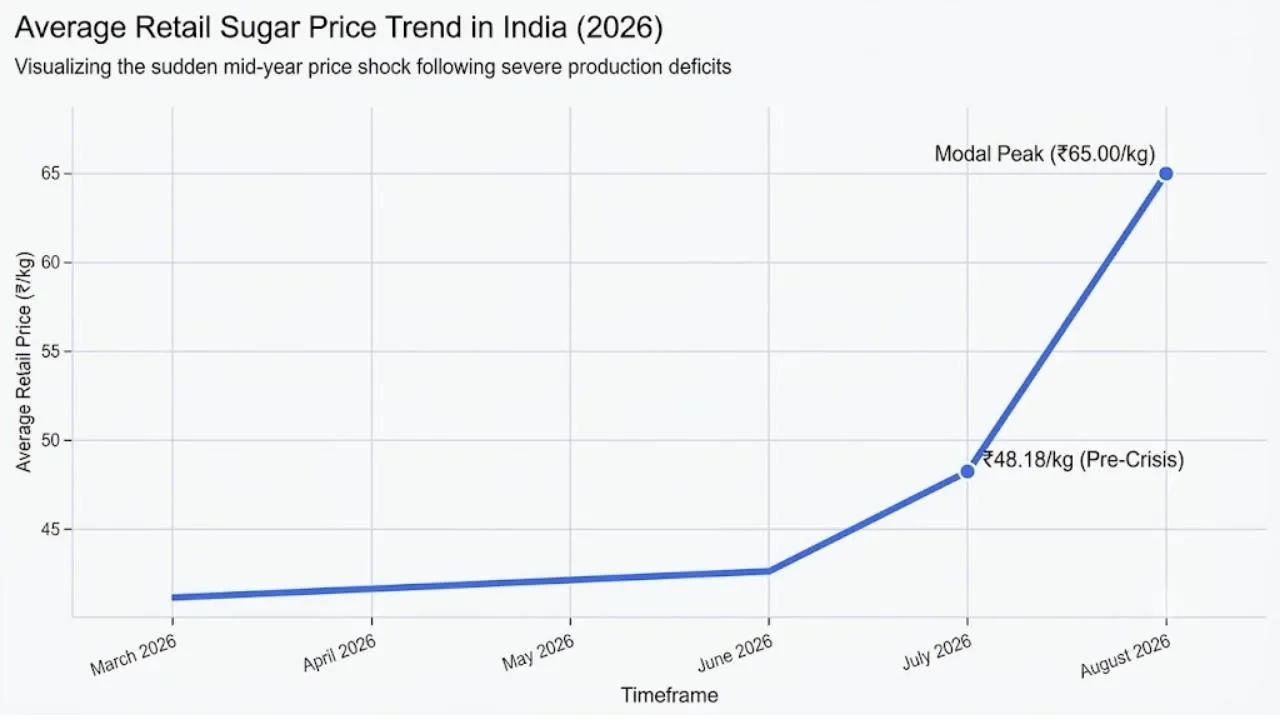
- In July 2026, retail sugar prices in India jumped from about ₹48 per kg to over ₹55 per kg by August 2026. During the holiday season, some stores reported prices close to ₹70 per kg.
- The sudden rise in sugar prices brought on by an imbalance between supply and demand is referred to as the “Sugar Price Crisis.” India saw a sharp increase in sugar prices in 2026 due to a fall in production predictions and stocks.
- One of the biggest producers and users of sugar worldwide is India. As a result, even a slight drop in output can put significant pressure on costs. There are worries regarding domestic availability because recent estimates indicate that sugar output has significantly decreased in comparison to previous projections.
- Consumers, food producers, confectionary companies, and government initiatives to control inflation have all been impacted by the problem.
What are Major Causes of the Sugar Price Crisis in India, 2026?
- Declining Sugar Production
- The issue is mostly caused by a dramatic drop in sugar production. The actual yield of sugar is now predicted to be just approximately 306 lakh metric tons (LMT), compared to the initial predictions of 343 LMT. The home supply was considerably constricted by this reduction.
- Adverse Weather Conditions
- Sugarcane harvests in key sugarcane-producing regions including Maharashtra, Karnataka, Gujarat, and portions of Uttar Pradesh were harmed by heavy rainfall, waterlogging, and adverse weather. These circumstances decreased sugar recovery rates and cane yields.
- Sugarcane Diseases
- Sugarcane plantations were impacted by agricultural diseases like Red Rot and Top Borer, which reduced output and degraded crop quality. The market’s supply of sugar was further diminished by these illness outbreaks.
- Declining Sugar Stocks
- Compared to other years, India’s opening stocks for the 2026 holiday season were lower. Decreased carryover inventory led to price rises and raised worries about future supply.
- Rising Festive Season Demand
- Traditionally, Raksha Bandhan, Ganesh Chaturthi, Dussehra, Diwali, and the wedding season are times when demand for sugar increases. The already limited supply was further stretched by the rise in consumption.
- Global Sugar Supply Tightening
- Due to supply issues in the main producing nations, sugar prices rose internationally in 2026. The Indian market was impacted by rising global prices, which increased the cost of domestic sugar. The predicted worldwide sugar shortage for 2026–2027 is 33 LMT.
- Ethanol Diversion Debate
- The diversion of sugarcane and sugar for the manufacturing of ethanol under India’s E20 fuel program is one of the most talked-about causes. The manufacture of ethanol, according to opposition parties, decreased the supply of sugar and exacerbated the problem.
- The government, however, argues that ethanol diversion is not the major factor and notes that the percentage of sugar diverted to ethanol has actually decreased in comparison to prior years. Tighter supplies may have been caused by ethanol, according to independent analyzes, but weather damage and production shortages were more significant factors.
What is the Status of India’s Sugar Industry?
| Indicator | Current Status |
|---|---|
| Global position | Among the biggest producers and users of sugar worldwide, India is the second-largest producer of sugarcane. |
| Sugarcane output | 500 million tons in 2025–2026, a 43.5% increase over 2015–2016. |
| Cultivated area | Grew to 58.87 lakh hectares in 2025–2026 from 49.27 lakh hectares in 2015–16. |
| Sugar production | 306 lakh tons in 2025–2026, as opposed to the original forecast of 343 lakh tons. |
| Major producers | Maharashtra and Uttar Pradesh, then Gujarat, Tamil Nadu, and Karnataka. |
What is Impact of the Sugar Price Crisis in India?
- Impact on Consumers
- As sugar prices rise, household grocery bills also rise.
- The monthly budgets of middle-class and low-income households are particularly strained.
- Sweets and confectionery goods become more expensive, which increases festival-related spending.
- Higher prices are frequently passed on to patrons by restaurants, tea shops, bakeries, and confectionery stores.
- Food Inflation Increases
- Increased costs for sugar add to the overall inflation of food prices.
- Sweets, chocolates, cookies, soft beverages, ice cream, and packaged goods are becoming more expensive.
- Growing food prices lower customers’ purchasing power and may limit desire for consumption.
- Impact on the Food and Beverage Industry
- Manufacturers of sweets must contend with rising production expenses.
- Raw material costs are higher for beverage firms.
- Local confectioners and small enterprises under pressure on their profit margins.
- To compensate for increased expenses, some businesses lower package sizes or raise product pricing.
- Impact on Retail Markets
- Purchase limitations have been implemented by several shops and quick-commerce sites.
- Stockpiling and panic purchasing can exacerbate supply shortages.
- Trader hoarding might lead to fake scarcity and further price increases.
- Impact on Sugar Mills
- Profitability may increase with higher sugar prices.
- Mill finances are strengthened by higher revenues.
- However, excessive profits may be limited by import regulations, anti-hoarding efforts, and government stock limitations.
- Future crop availability and output levels are likewise unknown for mills.
- Impact on Government and Public Policy
- Sugar merchants’ stock limitations.
- limitations on the stock holdings of large customers.
- Sugar stockpiles are physically verified.
- sugar imports free of duty.
- early start of the crushing process for sugarcane.
- Impact on Farmers
- The income of sugarcane growers may increase if sugar prices rise.
- Sugar mills with greater finances could be able to pay farmer debts faster.
- According to government data, farmers have already received a sizable portion of sugarcane payouts.
- There are still issues with labor costs, rising agricultural prices, irrigation costs, and late payments.
- Alternative crops that yield quicker yields are being adopted by certain farmers.
- Despite rising sugar prices, sugarcane acreage has decreased in some areas.
What Steps has the Government Taken to Control the Price of Sugar?
- Duty-Free Imports
- In order to increase domestic supplies prior to the holiday season, the government allowed the import of 10 lakh tons of raw sugar at zero tax under the Tariff Rate Quota until October 31, 2026.
- Stock Limit on Dealers
- In order to prevent hoarding and fake scarcity, sugar merchants are prohibited from holding more than 400 tons of sugar between August 1st and November 30th, 2026.
- Restriction on Bulk Consumers
- In order to avoid excessive inventory building by makers of confections, beverages, and biscuits, bulk customers are not allowed to keep sugar inventories longer than 15 days of consumption starting on September 1st, 2026.
- Restriction on Sugar Exports
- In order to prioritize domestic availability and stop further supply depletion, the government banned sugar exports until September 30, 2026, after previously allowing them.
- Diversification of Ethanol Feedstock
- To ease the strain on sugarcane-based feedstock, more ethanol is being produced from maize and other cereals. Nowadays, cereals account for about three-fourths of ethanol production.
Is the Increase in Sugar Prices Due to the Diversion of Sugarcane for Ethanol Production?
| The Reasons for Blaming Ethanol Diversion | Why Ethanol Is Not the Main Reason |
|---|---|
| In 2025–2026, almost 30 lakh tons of sugar equivalent were used to produce ethanol. | From around 12% in 2022–2023 to 9% in 2025–2026, sugar was diverted for ethanol. |
| An estimated 279 lakh tons of sugar were produced for consumption each year, compared to 280–285 lakh tons of demand. | Grains, especially maize, now account for about three-fourths of ethanol production, relieving strain on sugarcane. |
| The amount available for making sugar is decreased when sugarcane juice and B-heavy molasses are converted to ethanol. | After evaluating domestic sugar needs and buffer supplies, the government sets the allowable diversion each year. |
| There may be less protection against output shocks if opening stockpiles drop from around 50 lakh tons to 35 lakh tons. | Waterlogging, crop illnesses, and insect infestations caused production forecasts to drop from around 343 lakh tons to 306 lakh tons. |
| Duty-free imports came when sugar was diverted and exports were allowed based on exaggerated output predictions. | Despite sufficient overall availability, hoarding, speculative purchases, and festival demand exacerbated the price increase. |
Conclusion
The complicated interrelationships between agricultural, weather, government policy, energy objectives, and consumer welfare are brought to light by the 2026 Indian sugar price crisis. Record-high sugar prices have been caused by a number of factors, including decreased sugar output, diminishing supplies, crop damage from weather, high holiday demand, and discussions about ethanol diversion.
Frequently Asked Questions (FAQs)
What is the Sugar Price Crisis in India, 2026?
The Sugar Price Crisis refers to the sharp rise in sugar prices caused by lower production, declining stocks, strong demand, and supply constraints.
Why have sugar prices increased in 2026?
Reduced sugar output, weather-related crop damage, declining stockpiles, holiday demand, and market supply issues are some of the main causes.
Has India banned sugar exports?
To guaranty domestic availability and manage inflation, India has kept export limits in place.
Is ethanol production responsible for the Sugar Price Crisis?
The matter is still up for dispute. While the government identifies decreased output and weather as the main culprits, others blame ethanol diversion for a portion of the deficit.
What steps has the government taken to control sugar prices?
Export limitations, duty-free imports, stock monitoring, and policy reviews pertaining to ethanol are important steps.
Sources:
- https://www.pib.gov.in/PressReleaseDetail.aspx?PRID=2303478®=3&lang=1
- https://www.bbc.com/news/articles/cm2r9y9eleno
- https://www.thehindu.com/business/Economy/why-is-there-a-sudden-increase-in-sugar-prices-explained/article71383190.ece
- https://www.indiatoday.in/india/story/sugar-retail-price-rise-ethanol-real-villain-agricultural-economist-ashok-gulati-explains-reason-e20-2979679-2026-08-26
- https://www.hindustantimes.com/india-news/sugar-surprise-how-india-went-from-surplus-to-shortage-101787620332890.html
Leave a Reply